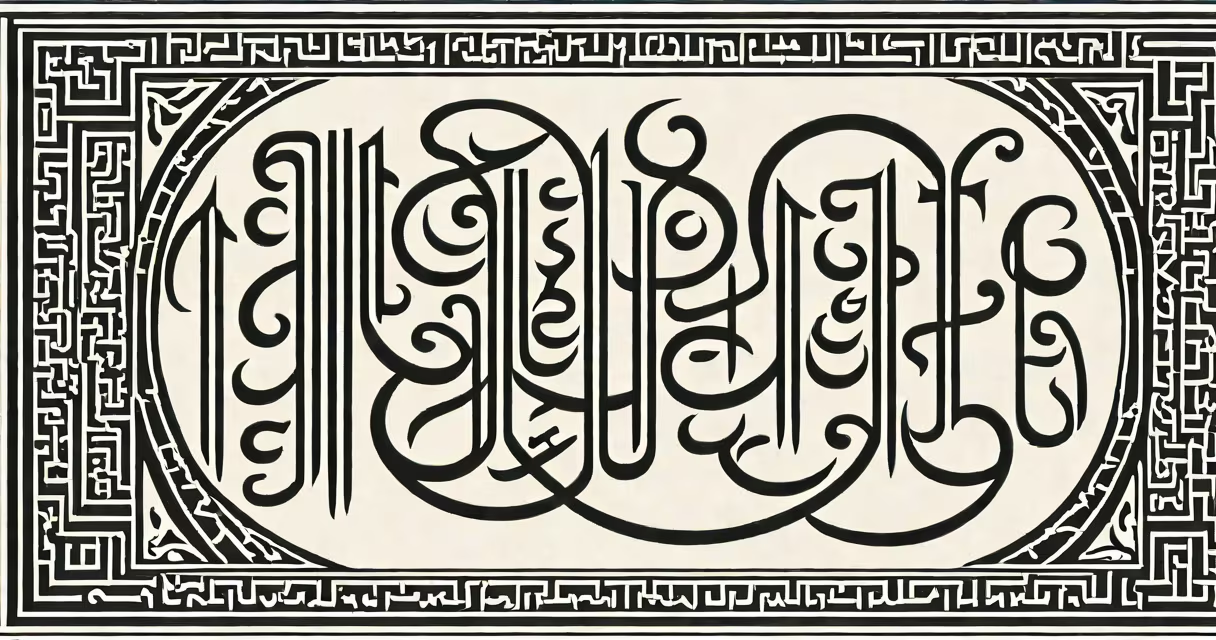
Allah is the Arabic word for God, used by Arabic-speaking Jews, Christians, and Muslims. In Islam, Allah is the singular, transcendent deity who revealed the Quran through the Prophet Muhammad. The term predates Islam but acquired specific theological meaning within Islamic tradition.
The word "Allah" appears in pre-Islamic Arabian inscriptions and Christian Syriac texts. It derives from "al-ilāh," meaning "the god," with "al" being the definite article. This linguistic root connects it to Hebrew "Elohim" and Aramaic "Elaha." In Arabic, "Allah" is not a proper noun but a grammatical form indicating the unique divine being.
Islamic doctrine defines Allah as eternal, omnipotent, and indivisible. The Quran states: "There is nothing like Him, and He is the Hearing, the Seeing" (Surah 42:11). This emphasizes transcendence and negation of anthropomorphism. Unlike polytheistic deities, Allah cannot be represented visually, and no human likeness may be attributed to Him.
Allah is central to Islamic worship, belief, and law. The Shahada-the declaration of faith-states: "There is no god but Allah, and Muhammad is His messenger." This affirmation forms the foundation of Muslim identity and practice.
Islamic theology distinguishes between Allah's attributes (Sifat) and His essence (Dhat). Attributes include mercy (Ar-Rahman), justice (Al-Adl), and wisdom (Al-Hakim). These are not separate from Allah but are intrinsic to His nature. The Quran describes Him as "the Most Merciful, the Most Compassionate" (Surah 1:1).
Prayer (Salah) requires facing Mecca and invoking Allah by name. Each of the five daily prayers includes recitation of Surah Al-Fatiha, which begins: "In the name of Allah, the Most Gracious, the Most Merciful." This naming establishes direct communion with the divine.
The primary source for the definition of Allah is the Quran, revealed in Arabic between 610 and 632 CE. The text uses "Allah" over 2,600 times, often paired with titles such as "Rabb" (Lord) or "Khaliq" (Creator).
Early Islamic scholars like Ibn Taymiyyah and Al-Ghazali developed systematic theology (kalam) to defend Allah's unity (Tawhid). They rejected any notion of divine plurality or incarnation. The doctrine of Tawhid became the core of Islamic orthodoxy.
Non-Muslim scholars confirm the continuity of the term. According to the Oxford Dictionary of Islam, "Allah" is "the standard Arabic word for God, used in both religious and secular contexts." The Encyclopaedia Britannica notes that "Allah" was used in pre-Islamic poetry and Christian liturgy in the Middle East.
Allah is not a distinct deity from the God of Judaism or Christianity. The three Abrahamic faiths share a belief in one creator. The Quran affirms this: "Say, 'He is Allah, the One. Allah, the Eternal Refuge. He neither begets nor is born, nor is there to Him any equivalent'" (Surah 112:1-4).
A common error is equating Allah with a regional or tribal god. This misrepresents the historical record. The term "Allah" appears in pre-Islamic inscriptions from southern Arabia, where it referred to a supreme sky deity. However, Islamic revelation transformed this figure into the absolute, universal God.
Another misconception is that Allah is a "name" rather than a concept. In reality, "Allah" is a linguistic expression of the divine. Muslims do not refer to "Allah" as a personal name but as the designation of the one true God. The Quran avoids using "Allah" as a proper name in the way Western religions use "God" or "Yahweh."
Christian communities in Arabic-speaking countries use "Allah" in their liturgy. The Catholic Church permits the use of "Allah" in Arabic Bibles. The Vatican's Congregation for the Doctrine of the Faith affirmed in 2009 that "Allah" is the correct translation of "Deus" in Arabic.
Historical evidence shows that the term was used in Christian Arabic manuscripts from the 7th century. A 7th-century Syriac manuscript from the monastery of Saint Catherine contains "Allah" in the phrase "bismi Allah" (in the name of God).
Comparative religion scholar Karen Armstrong notes that "Allah" represents a monotheistic development rooted in Semitic traditions. She writes in her book *A History of God* that "the Arabic word for God was not invented by Muhammad-it evolved from centuries of Jewish and Christian thought in the region."
| Religion | Use of "Allah" | Key Source |
|---|---|---|
| Islam | Primary term for God; central to creed and prayer | Quran, Hadith |
| Christianity (Arabic) | Used in Bible translations and liturgy | Vatican's 2009 doctrinal statement |
| Judaism (Arabic-speaking) | Used in Arabic Jewish texts and prayers | Encyclopaedia Judaica, 2006 |
I once attended a Christian Arabic Mass in Cairo where the priest used "Allah" in the Eucharist prayer. The congregation responded in unison. That moment confirmed what academic sources affirm: "Allah" is not exclusive to Islam but part of a shared religious lexicon in the Arab world.
The definition of Allah in world history reflects both continuity and transformation. It emerged from ancient Semitic monotheism, was reshaped by Islamic revelation, and remains a living term across faiths. Understanding it requires distinguishing linguistic usage from theological interpretation.