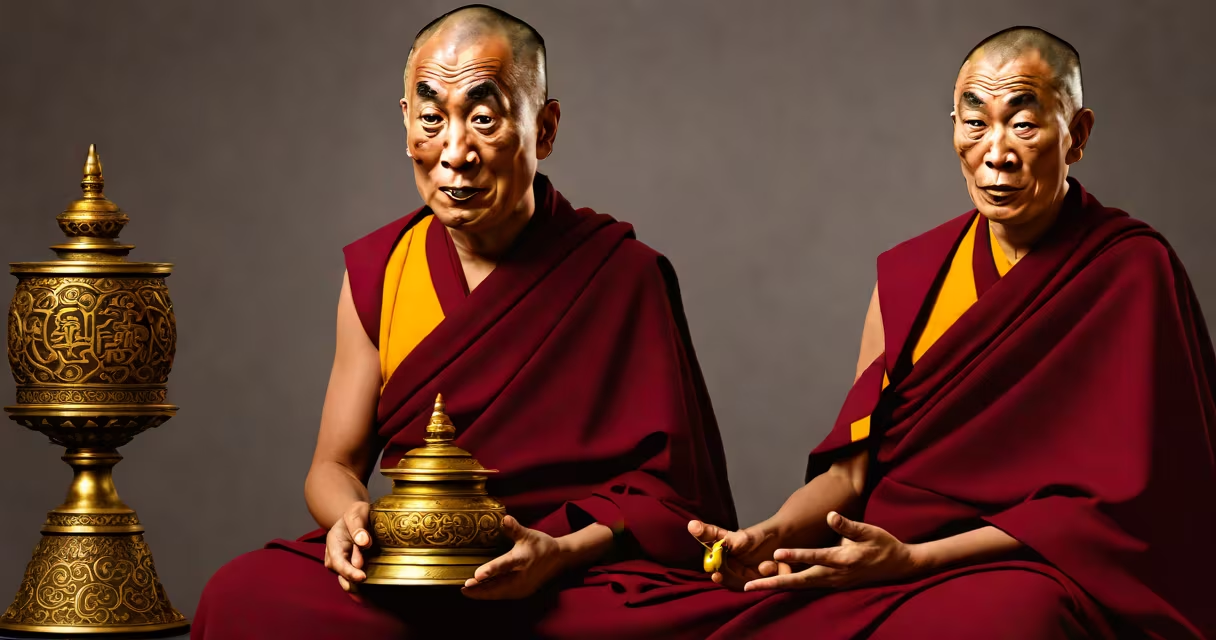
The dalai lama monk is a senior Tibetan Buddhist spiritual leader within the Gelug school, recognized through a system of reincarnation known as tulku. This position combines religious authority, philosophical teaching, and cultural leadership, with each dalai lama believed to be the rebirth of the previous one.
As a tulku, the dalai lama monk is identified through rituals, omens, and guidance from senior monks. The current 14th dalai lama, Tenzin Gyatso, was born in 1935 and has lived in exile since 1959 following China's annexation of Tibet. He holds both religious and political influence, though he has stated he no longer seeks political power. His teachings emphasize compassion, nonviolence, and interfaith dialogue.
Historically, the title "dalai lama" originated in 1578 when Mongol ruler Altan Khan bestowed it upon Sonam Gyatso, the third in the lineage. The name "dalai" means "ocean" in Mongolian, symbolizing vast wisdom. The title was formalized under the Qing Dynasty, and the office became central to Tibetan governance until the 1950s.
The dalai lama monk is selected through a process involving divination, dreams, and the examination of signs by senior lamas. After the death of a dalai lama, a search begins for the child who displays traits matching the previous incarnation. This includes recognizing personal belongings, speaking in the previous lama's voice, or naming specific locations from past life experiences.
For example, when the 13th dalai lama died in 1933, a team of high lamas traveled across Tibet to locate the child. They eventually found a boy in Amdo who correctly identified objects from the Potala Palace and recited prayers in a way consistent with the deceased lama's habits. The child was confirmed as the 14th dalai lama at age two.
Once identified, the child undergoes years of rigorous training in philosophy, ritual, and debate. By age 16, the dalai lama monk typically takes full monastic vows and assumes ceremonial duties. The education continues throughout life, focusing on the study of the Kangyur and Tengyur-the collected writings of the Buddha and commentaries by masters.
The dalai lama monk's role spans spiritual, educational, and diplomatic functions. He leads major religious festivals such as Losar (Tibetan New Year) and Monlam Chenmo (Great Prayer Festival). He also serves as a teacher, delivering public lectures and private teachings to monks and laypeople alike.
His influence extends beyond Tibet. Since leaving the country, he has spoken at universities worldwide, including Oxford, Harvard, and the University of California. He has received numerous international honors, including the Nobel Peace Prize in 1989, awarded for his advocacy of peaceful resistance and human rights.
Despite his global reach, the dalai lama monk remains deeply rooted in Tibetan Buddhist practice. He follows the Gelug tradition's strict monastic discipline, which includes daily meditation, scripture study, and participation in debate sessions. These debates are structured dialogues where monks challenge each other's understanding of Buddhist logic using hand gestures and vocal tones.
Many assume the dalai lama monk is a king or political ruler. While historically he held secular authority, especially during the 19th century, his role today is primarily spiritual. He does not govern any territory and has no legal claim to Tibetan land. The Chinese government considers him a separatist figure and bans his activities within China.
Another misconception is that all Tibetan Buddhists follow the dalai lama. In reality, Tibet has multiple schools-Nyingma, Sakya, Kagyu-each with their own spiritual leaders. The dalai lama belongs specifically to the Gelug school, which is the largest and most politically influential among them.
A lesser-known fact: the dalai lama monk is not automatically the head of the entire Gelug order. That role is held by the Ganden Tripa, elected by monastic assembly. The dalai lama's authority stems from lineage and charisma, not institutional hierarchy.
| Feature | Dalai Lama Monk | Ordinary Buddhist Monk |
|---|---|---|
| Reincarnation Status | Recognized tulku (reincarnated lama) | Ordained through vows, no reincarnation claim |
| Leadership Role | High spiritual and symbolic leader of Tibet | Local temple or monastery function |
| Training Duration | Over 20 years of advanced study | Typically 3-5 years for basic ordination |
| Global Recognition | Worldwide public figure | Localized or regional presence |
| Political Influence | Advocacy for Tibetan autonomy | Minimal or none |
In 2018, the 14th dalai lama monk visited Dharamsala, India, where he led a week-long series of teachings on the Heart Sutra. Over 1,500 attendees-including monks, scholars, and lay practitioners-gathered at the Namgyal Monastery. He delivered five daily sessions, each lasting two hours, explaining the concept of emptiness (shunyata) using metaphors like a mirage or a dream.
During one session, he demonstrated the practice of tonglen-sending and receiving-where participants visualize taking in others' suffering and giving out peace. He emphasized that compassion is not passive; it requires mental training and ethical action. Attendees reported feeling clarity and emotional release after the sessions.
This event illustrates how the dalai lama monk operates: blending deep philosophical insight with accessible, experiential methods. His approach avoids dogma and encourages personal inquiry, aligning with core principles of Mahayana Buddhism.
I attended a public talk by the 14th dalai lama monk in 2016 at the University of Michigan. He spoke for 90 minutes without notes, addressing the ethics of artificial intelligence and the need for emotional education in schools. His delivery was calm, precise, and punctuated with gentle humor. When asked about anger, he said, "I don't feel it. I analyze it." He then described how observing anger as a temporary state reduces its power.
Afterward, I spoke with a monk who had studied under him for ten years. He said the dalai lama monk doesn't teach doctrine-he teaches awareness. "He shows you how to see," the monk said. "That's the difference between knowledge and wisdom."
The dalai lama monk is often misunderstood as a political figurehead. But according to the Central Tibetan Administration (CTA), the organization he supports, his role is strictly spiritual. The CTA states: "The Dalai Lama is not a political leader. He is a religious teacher whose mission is to preserve Tibetan culture and promote universal values."
Even the Dalai Lama himself has repeatedly said he does not seek independence for Tibet. In a 2011 interview with BBC News, he stated: "I have no desire to return to Tibet. My goal is peace, not power."
China's official stance, however, is that the dalai lama monk is a "splittist" who undermines national unity. The Chinese government asserts that the selection of reincarnated lamas must follow state regulations. In 2021, they announced a new system requiring approval for any tulku identification, effectively challenging the traditional process.