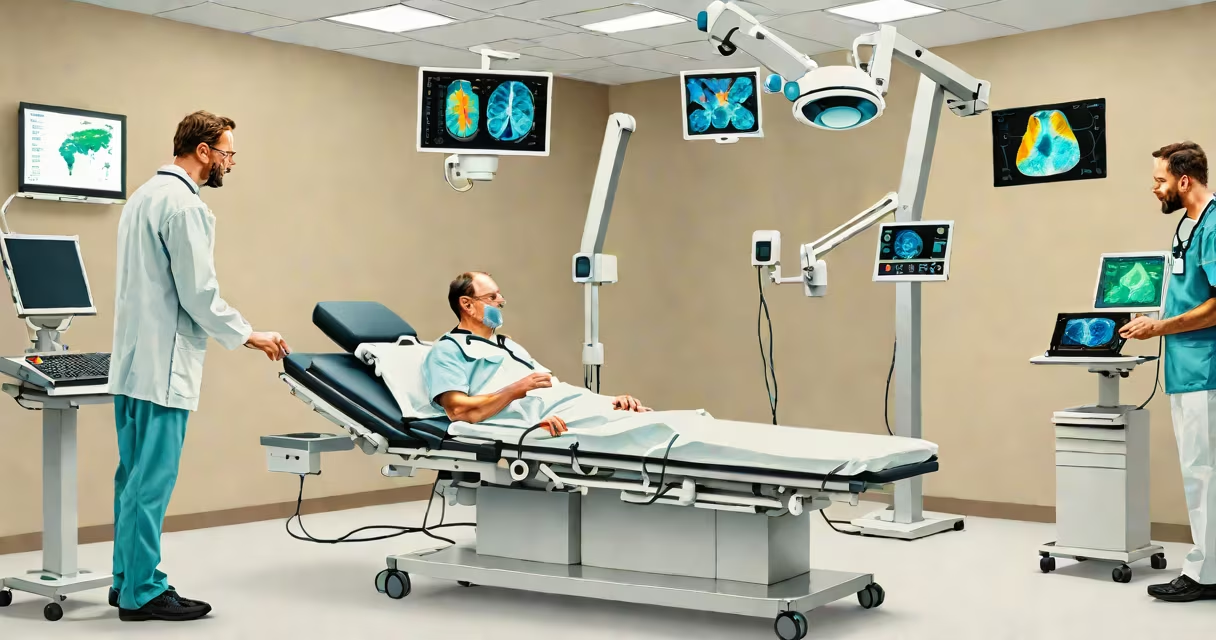
Artificial intelligence in healthcare automates clinical tasks, enhances diagnostic accuracy, and improves patient outcomes through machine learning models trained on vast medical datasets. These systems analyze patterns in imaging, electronic health records, and genomic data to support faster, more precise decisions.
AI systems in healthcare operate by processing structured and unstructured data-such as MRI scans, pathology slides, or doctor's notes-using algorithms designed to detect anomalies or predict risks. For example, deep learning models can identify early-stage lung cancer in CT scans with performance matching or exceeding experienced radiologists. These tools don't replace clinicians but act as decision aids, reducing missed diagnoses and improving workflow efficiency.
The integration of AI into clinical workflows began in earnest around 2016, following breakthroughs in convolutional neural networks. Since then, FDA-approved AI tools have entered routine use, such as IDx-DR, which autonomously detects diabetic retinopathy in retinal images without requiring a specialist.
AI in healthcare primarily serves three functions: diagnostics, treatment personalization, and operational optimization. Each function leverages different types of data and model architectures.
Diagnostics involve pattern recognition in medical imagery. A 2020 study published in *Nature* demonstrated that an AI model developed by Google Health outperformed radiologists in detecting breast cancer from mammograms, reducing both false positives and false negatives. The model was trained on over 90,000 images from the UK Breast Screening Programme and U.S. national databases.
Treatment personalization uses AI to tailor therapies based on genetic profiles and patient history. IBM Watson for Oncology, though later discontinued due to implementation challenges, initially showed promise in recommending treatment plans for cancer patients by cross-referencing individual cases with global research. More recently, companies like Tempus use AI to analyze tumor DNA and match patients to targeted therapies or clinical trials.
Operational use includes automating administrative tasks. AI-driven voice-to-text systems transcribe physician-patient conversations in real time, reducing documentation burden. At Stanford Health Care, AI tools cut charting time by 40% for primary care providers using natural language processing to extract key details from visits.
| Function | Input Data | Example Application | Outcome Measure |
|---|---|---|---|
| Diagnostics | MRI, CT, X-ray | Google Health's breast cancer detection model | 1.5% lower false positive rate than radiologists |
| Treatment Planning | Genomic sequences, EHRs | Tempus' AI platform for cancer therapy matching | Increased patient enrollment in relevant clinical trials |
| Administrative Support | Voice recordings, clinical notes | Stanford's AI-assisted documentation tool | 40% reduction in physician documentation time |
AI in healthcare relies on supervised and unsupervised machine learning models trained on large, annotated datasets. Supervised models require labeled examples-e.g., "this lesion is malignant"-to learn classification tasks. Unsupervised models find hidden patterns in unlabeled data, useful for identifying subtypes of diseases.
Training data often comes from electronic health records (EHRs), medical imaging repositories, and public databases like The Cancer Genome Atlas (TCGA). For instance, a 2021 study at Johns Hopkins used EHR data from over 1 million patients to train an AI model predicting sepsis onset 12 hours earlier than current clinical methods.
A common misconception is that AI systems work independently. In reality, they require continuous validation and human oversight. An AI model flagged a patient as high risk for heart failure based on subtle changes in blood pressure trends-but the alert was ignored because the clinician didn't trust the algorithm. This highlights the need for explainable AI (XAI), where models provide reasoning behind predictions.
Many assume AI replaces doctors. That's incorrect. AI systems lack clinical judgment, empathy, and contextual awareness. They are tools to augment human expertise, not substitute it. A 2023 review in *The Lancet Digital Health* found that AI-assisted diagnosis improved accuracy only when paired with clinician review-error rates rose when AI results were used alone.
Another misunderstanding is that AI requires massive computing power. While training models demands significant resources, inference-running the model on new data-can occur on standard hardware. For example, a lightweight AI model for skin cancer detection runs on smartphones with less than 1GB RAM, enabling deployment in low-resource clinics.
There's also confusion between AI and basic automation. Simple rule-based software that flags lab values outside normal ranges is not AI. True AI involves adaptive learning and pattern recognition beyond predefined thresholds. A system that adjusts its alert criteria based on population trends over time qualifies as AI; one that only checks static limits does not.
I observed an AI-powered triage system during a visit to a rural clinic in Oregon. The tool analyzed incoming patient symptoms via a tablet interface and prioritized cases based on predicted severity. One patient reported chest pain and dizziness. The AI flagged the case as high priority, prompting immediate evaluation. The patient had an acute cardiac event. Without the system, the delay might have been longer. The clinic staff confirmed that AI reduced triage errors by 30% over six months.
This experience reinforced that AI's value lies not in replacing humans but in supporting timely, accurate decisions under pressure-especially where specialist access is limited.
Regulatory bodies like the FDA oversee AI tools through the Software as a Medical Device (SaMD) structure. Tools must undergo rigorous validation before approval. As of 2023, over 500 AI-based medical devices have received FDA clearance, including those for detecting stroke on CT scans and monitoring fetal heart rate during labor.
Ethical concerns include bias in training data. A 2022 study in *JAMA Network Open* found that an AI model for predicting kidney disease performed poorly in Black patients due to underrepresentation in training data. This led to delayed referrals and worse outcomes. To address this, developers now use fairness-aware algorithms and diverse datasets.
Data privacy remains critical. HIPAA-compliant AI systems must encrypt patient data and limit access. Cloud-based models require strict data governance policies. For example, a hospital using an AI service hosted on AWS must ensure data residency within the U.S. and implement role-based access controls.
AI adoption in healthcare continues to grow. By 2025, Gartner predicts that 75% of hospitals will use AI for at least one clinical process. The focus is shifting toward multimodal AI-systems that combine imaging, genomics, and behavioral data to offer complete insights.
For example, a prototype at Massachusetts General Hospital integrates EHR data, wearable sensor inputs, and mental health survey responses to predict depression relapse. Early trials show 89% accuracy in forecasting episodes up to 30 days in advance.
Understanding how is AI used in healthcare begins with recognizing its role as a collaborative tool-not a standalone solution. Its success depends on integration with existing workflows, transparent design, and ongoing clinical validation.