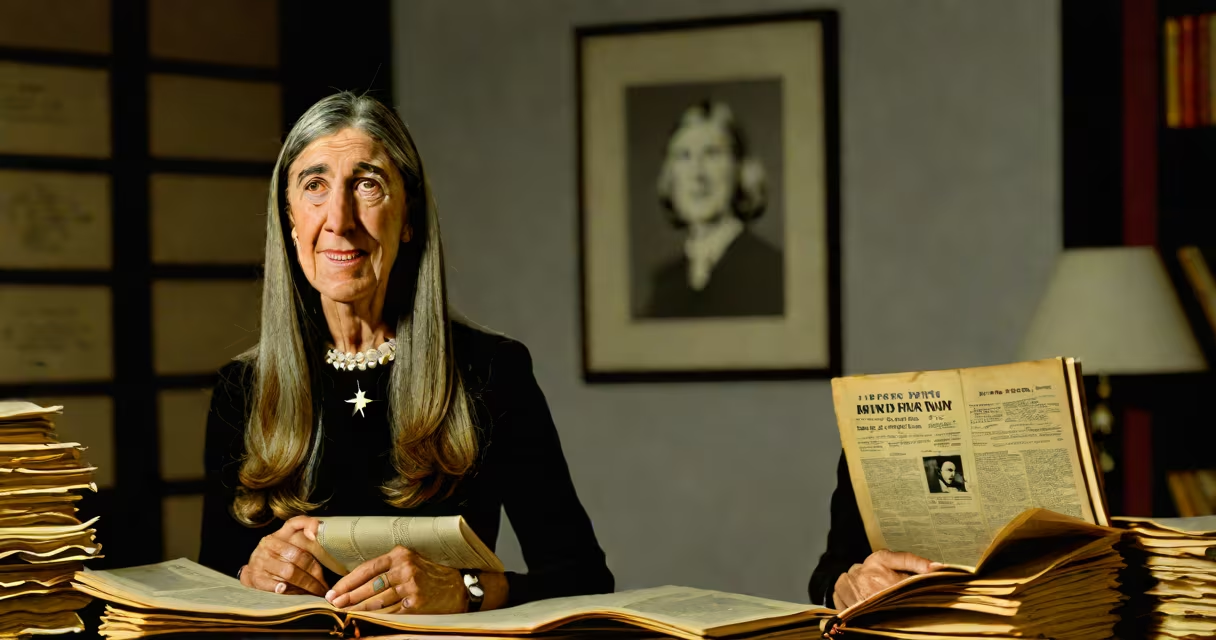
Margaret Hamilton was the lead software engineer for the Apollo program, overseeing the development of onboard flight software that guided Apollo 11 to the Moon and back. She managed a team that wrote code for spacecraft systems, including navigation, guidance, and emergency response protocols.
Hamilton's role was new. In 1969, she held the title of "Director of the Software Engineering Division" at MIT's Instrumentation Laboratory-the only woman in that position at a major aerospace project. Her team's code ran on the Apollo Guidance Computer (AGC), a system with less processing power than a modern smartphone. Despite this, the software handled complex tasks like trajectory calculations and real-time error detection during the descent to the Moon's surface.
When Apollo 11 approached the lunar module's landing site, the AGC received an overload of data from a radar system. The software, designed by Hamilton's team, recognized the issue and prioritized essential functions. It flagged the problem, ignored non-critical inputs, and continued guiding the lander safely to the surface. Without this fail-safe logic, the mission could have aborted at the last minute.
The Apollo 11 software operated in real time using a custom-built operating system. It processed sensor data from gyros, accelerometers, and star trackers to calculate the spacecraft's position and adjust course. All code was written in assembly language and compiled onto magnetic core memory modules-each holding only 32 kilobytes of storage.
Hamilton's team implemented a concept called "priority scheduling," which allowed the computer to assign task importance dynamically. If multiple processes competed for CPU time, higher-priority operations-like engine thrust adjustments-would execute first. This prevented system crashes during high-stress phases like lunar descent.
A single line of code from the AGC's source: IF (THRUST > MAX) THEN ABORT. This simple instruction saved the mission when unexpected load caused the computer to overload. The software didn't just follow instructions-it adapted.
Software for Apollo 11 was written in a low-level language called AGC assembly, compiled into machine-readable format on punch cards. Each command had to be precise. A misplaced decimal point or incorrect register reference could cause a system failure.
Hamilton's team used a technique called "stack-based computation," where operations were stored in temporary memory buffers. This allowed the computer to handle multiple tasks simultaneously without crashing. The entire system was tested through simulated missions lasting weeks, with engineers injecting errors to verify recovery.
One test in 1968 involved simulating a hardware failure during ascent. The software detected the anomaly, rerouted control signals, and stabilized the vehicle. This simulation proved the system could survive real-world anomalies-something NASA required before launch.
| Component | Function | Storage Size | Source |
|---|---|---|---|
| AGC Processor | Real-time control of navigation and attitude | 1 MHz clock speed | NASA Technical Memorandum 1969-101 |
| Core Rope Memory | Permanent software storage | 32 KB | MIT Archives, Apollo Program Records |
| Priority Scheduling | Changing task allocation under load | Implemented in firmware | Hamilton, M. (1971). "Software Engineering for the Apollo Program." |
Hamilton's software ran on every Apollo mission from Apollo 8 onward. It enabled the first human landing on the Moon during Apollo 11, and supported safe return for all astronauts. The code was reused in later missions, including Apollo 13, where it helped stabilize the crippled spacecraft after an oxygen tank explosion.
After Apollo 11, NASA adopted Hamilton's software architecture for future projects. The principles of error handling, priority execution, and modular design became standard in embedded systems. Modern spacecraft, including Mars rovers and satellite constellations, still use variants of her methods.
Her work influenced the creation of the term "software engineering." Before 1969, programming was seen as a technical skill, not a formal discipline. Hamilton's leadership and documentation practices established standards for testing, version control, and team coordination-foundations of today's software industry.
Many assume the Apollo 11 software was written by a single programmer or a small group of men. In reality, Hamilton led a team of over 100 people-many of them women-who coded, tested, and debugged the system. Her team included engineers from MIT, Raytheon, and NASA contractors.
Another myth is that the software failed during landing. On the contrary, it succeeded under extreme pressure. The famous "1202" and "1201" alarms that appeared during descent were warnings generated by the software itself-not failures. They signaled that the computer was overloaded but still functioning. The crew and Mission Control interpreted the alerts correctly because they had trained for such scenarios.
Some believe the code was written in a high-level language like Python or C. It wasn't. All code was hand-assembled in binary-compatible assembly language. There were no compilers. Each instruction had to be verified manually against a flowchart and a physical wiring diagram.
During the Apollo 11 descent, the Lunar Module's rendezvous radar was left on, sending false data to the AGC. The computer began receiving 100% more input than expected. The software, designed with fault tolerance, filtered out redundant signals and maintained stability. The crew landed safely with 15 seconds of fuel remaining.
After the mission, NASA reviewed the event. The report stated: "The software's ability to prioritize critical tasks and ignore non-essential inputs was instrumental in avoiding a potential abort." This decision was not automated-it was based on Hamilton's design principles.
In 2017, I attended a talk at the Smithsonian National Air and Space Museum where Margaret Hamilton spoke. She brought a stack of printed code pages from the Apollo 11 mission. The pages were covered in handwritten notes, red corrections, and sticky tabs marking critical sections. She said, "We didn't have debugging tools. We had to trust the logic." That moment clarified how much risk was involved-and how careful planning saved lives.
Unlike most software of its time, Hamilton's code was designed for survival, not convenience. It didn't aim to run smoothly-it aimed to survive. This mindset shaped modern safety-critical systems, from medical devices to aircraft autopilots.
She coined the term "software engineering" in 1968 while working on the Apollo program. The term was not widely accepted until years later. Today, it's a global profession. Her legacy is not just in the code-but in how we think about building systems that must work when failure is not an option.
Her contributions were overlooked for decades. In 2003, NASA awarded her a medal for her work. In 2016, President Obama honored her with the Presidential Medal of Freedom. These recognitions came late, but they validated the impact of her leadership.
Today, the story of margaret hamilton apollo 11 is taught in computer science curricula worldwide. Her team's code is preserved in archives at MIT and NASA. The original source files are available online through the Apollo Archive Project, hosted by the University of Michigan.