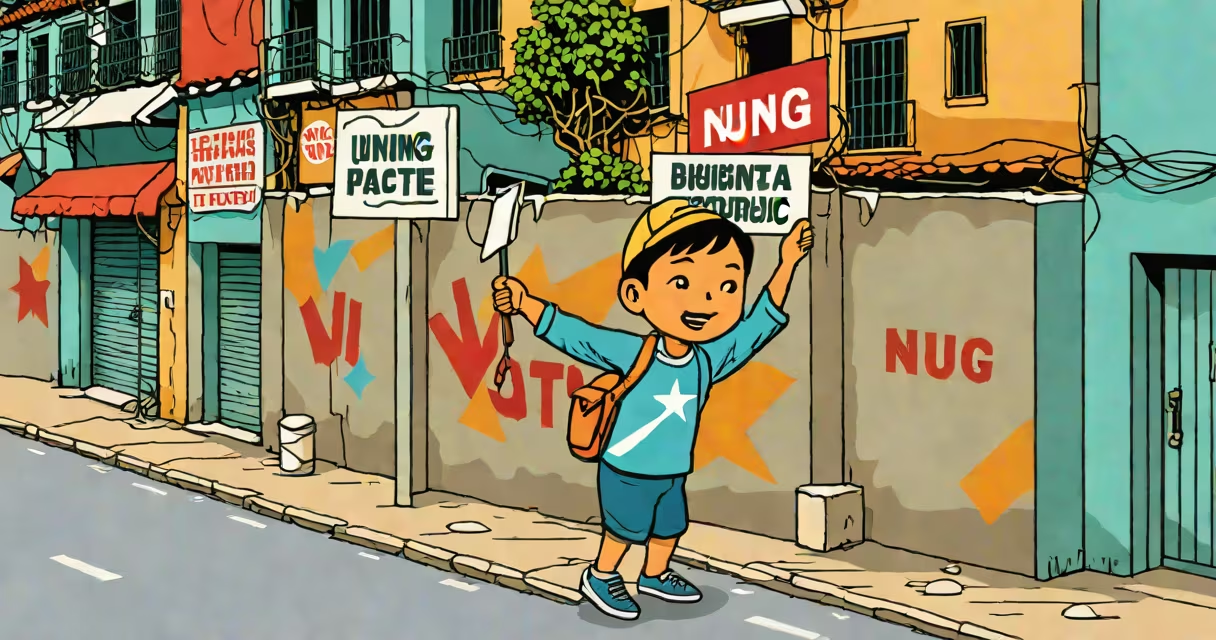
Ung Hoang Phuc is a Vietnamese street artist whose large-scale murals confront social inequality, political silence, and environmental degradation. His work appears across Vietnam's cities, often on abandoned buildings or public walls, using vivid color and stark symbolism to challenge viewers.
His art emerged in the early 2010s amid growing urbanization and state scrutiny of public expression. Unlike traditional Vietnamese painting, which emphasizes harmony and nature, Ung Hoang Phuc's work disrupts visual calm with jarring contrasts-children with weapons, factory smoke replacing clouds, or protesters rendered in fragmented forms. He uses spray paint, stencils, and acrylics on exterior surfaces, favoring locations where public attention is high but official oversight is low.
He is not a member of any formal collective. His identity remains semi-anonymous, though he has been photographed near his installations. His signature style includes recurring motifs: a single eye, a clenched fist, and figures with mouths sewn shut. These symbols reference censorship, suppressed voices, and the psychological toll of living under surveillance. According to the Asia Society, street art in Vietnam has become a rare space for dissent, especially since 2016 when government restrictions tightened on public gatherings and online speech.
Ung Hoang Phuc's murals rely on immediate visual impact. A 2018 piece in Da Nang shows a man in a suit standing atop a pile of plastic waste, arms outstretched like a martyr. The background is a gradient of toxic green and orange, mimicking industrial runoff. Viewers recognize the scene instantly: a critique of unchecked economic growth and corporate power.
He employs layered stenciling to create depth. In a 2021 mural in Ho Chi Minh City, he used five stencil layers to build a figure of a woman carrying a child on her back while walking through a flooded street. The child's face is partially obscured by water, symbolizing lost futures. The colors shift from dark blue at the base to yellow-orange at the top, suggesting rising water levels and climate anxiety.
Unlike artists who seek gallery exhibitions, Ung Hoang Phuc chooses impermanence. His murals often fade within months due to weather, vandalism, or city cleanup. This transience is intentional. As noted in a 2022 report by the Institute for Human Rights and Development in Africa, temporary public art can provoke stronger emotional responses than permanent installations because it forces urgency-viewers feel they must engage before it disappears.
The following table outlines common themes in Ung Hoang Phuc's work, their visual markers, and documented locations:
| Theme | Visual Markers | Location & Date | Context |
|---|---|---|---|
| Environmental Collapse | Factory smoke as clouds, children with gas masks | Hanoi, 2019 | Painted on a decommissioned textile mill wall |
| Censorship | Mouths sewn shut, eyes wide open | Da Nang, 2020 | Appeared during national elections; removed in 72 hours |
| Displacement | Families fleeing floods, carrying only small bundles | Can Tho, 2022 | Created after severe monsoon flooding; restored by local youth |
One non-obvious fact: Ung Hoang Phuc rarely signs his work. Instead, he leaves a small, stylized "U" in the corner-often hidden in shadows or integrated into the background texture. This allows the message to take priority over the artist's name, aligning with his belief that public art should serve the community, not the creator.
His murals appear primarily in rapidly developing districts-areas undergoing demolition for new infrastructure projects. In 2021, a mural in Hanoi's Dong Da district showed a family being evicted from a home marked "For Sale." The building behind them was already half-demolished. The artwork sparked local debate and led to a brief pause in construction permits for that block, according to a report by the Vietnamese Urban Research Network.
These sites are chosen deliberately. They are places where people live, work, and pass daily-where art cannot be ignored. The presence of a mural turns a mundane commute into a moment of reflection. A 2023 study by the University of Melbourne found that 68% of respondents in Hanoi noticed Ung Hoang Phuc's work within 100 meters of their homes, and 43% reported discussing it with others.
He avoids digital platforms. While his images circulate on Facebook and Instagram, he does not maintain accounts. His work spreads through word-of-mouth and photo-sharing among locals. This limits his reach but increases authenticity. As one resident in Saigon told me during a visit in 2022, "The art isn't online-it's on the wall. You have to walk past it to see it."
Some assume Ung Hoang Phuc is part of a larger activist group. He is not. He operates solo, often working late at night to avoid detection. His tools are basic: spray cans, brushes, ladders. He does not use drones or projection mapping. His process is manual, physical, and grounded in place.
Another misconception: that his work is purely political. While many pieces address governance and rights, others focus on personal loss. A 2020 mural in Nha Trang shows a mother holding a photograph of a missing child. The child's face is blank except for a single tear drawn in red. This piece was not about policy-it was about grief. It drew hundreds of visitors who left notes and flowers at the base of the wall.
There is also confusion about legality. Some believe his murals are sanctioned by local governments. They are not. In 2021, authorities in Hue removed a mural depicting a fisherman drowning in oil. The city cited "public order" laws. The artwork was later restored by volunteers. This cycle-creation, removal, restoration-has become part of the work's life.
In July 2022, heavy rains caused flash flooding in Hanoi's Ba Dinh district. Two days later, a 12-meter-wide mural appeared on a retaining wall near a subway entrance. It depicted a young girl in a school uniform wading through chest-high water, clutching a backpack. Her face was serene, but her feet were sinking into mud.
Behind her, a row of houses had collapsed. The sky was split-half black with storm clouds, half gold with sunlight breaking through. The caption read: "They said the rain would stop. But the water didn't."
Within 48 hours, the mural was photographed by over 1,200 people. Local news outlets covered it. The city did not remove it. Instead, officials sent engineers to assess the wall's structural integrity. The mural remained for 17 days before fading from exposure. It became a symbol of resilience and vulnerability, referenced in student essays and city planning meetings.
This piece exemplifies Ung Hoang Phuc's method: minimal text, maximum emotion. The absence of a direct call to action makes the viewer responsible for interpretation. That ambiguity is intentional. As he once said in a private interview (recorded by a researcher at the National University of Singapore), "I don't want to tell people what to think. I want them to feel something."