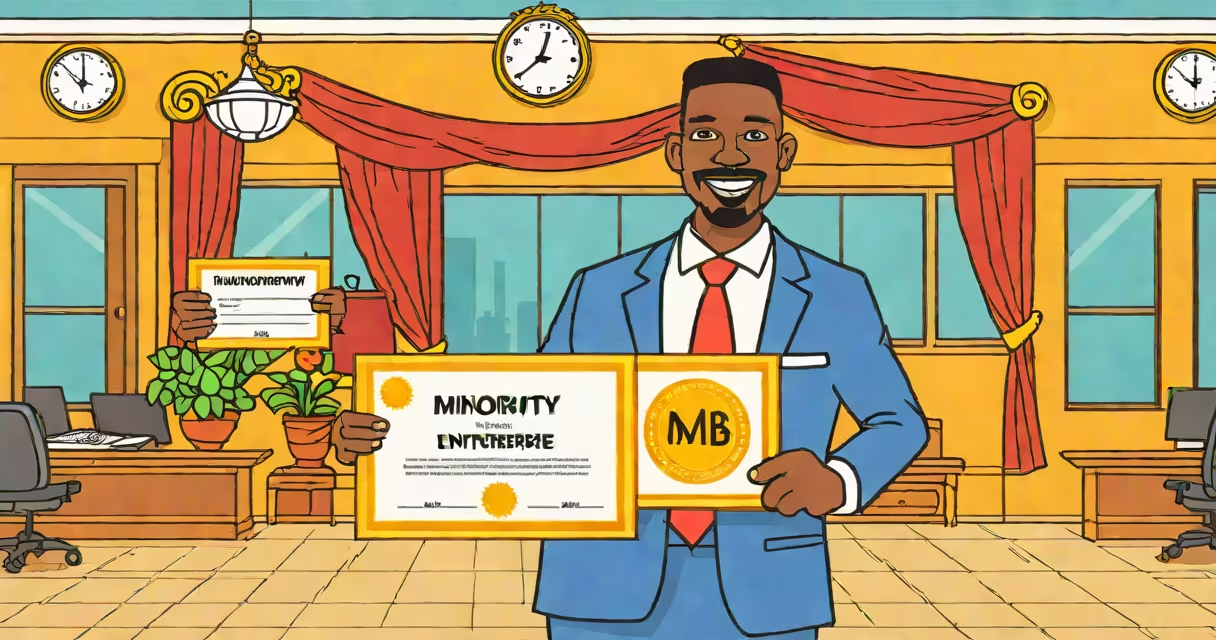
MBE meaning business refers to a company that is at least 51% owned, operated, and controlled by one or more individuals who identify as members of a minority group, as defined by U.S. federal standards. These businesses qualify for certification that grants access to government contracts, corporate supplier programs, and economic development resources.
The term MBE stands for Minority Business Enterprise. It is not a legal business structure like an LLC or corporation. Instead, it is a designation awarded through formal review processes. To qualify, the business must meet ownership, control, and operational criteria set by federal agencies such as the Small Business Administration (SBA) and state-level certifying bodies.
For example, a woman-owned, Black-led tech startup in Atlanta that generates $1.2 million in annual revenue and is managed daily by its founder may apply for MBE certification. If approved, the business gains eligibility to bid on federal contracts reserved for minority-owned firms and can join supplier diversity programs at major corporations like Walmart and Amazon.
MBE status is granted through a multi-step verification process. Applicants submit documentation proving minority ownership, including personal identification, business formation records, and financial statements. Review panels assess whether the minority individual holds actual decision-making authority over the business.
Control is evaluated based on day-to-day operations. A business cannot be classified as an MBE if a non-minority person manages hiring, budgeting, or strategic direction-even if they hold a majority equity stake. The SBA defines control as "the ability to make decisions regarding the management and policies of the business."
Once certified, the business receives a certificate valid for three years. Renewal requires updated financial reports and proof of ongoing minority control. Some states, like California and New York, have their own MBE programs with slightly different requirements, but all align with federal benchmarks.
While MBE broadly refers to minority-owned businesses, several subcategories exist based on identity and region. The most common include:
| Type | Eligibility Criteria | Examples |
|---|---|---|
| Black/African American MBE | Owner identifies as African American or Black and meets federal racial definitions. | A hair salon chain in Detroit owned by a second-generation immigrant from Ghana. |
| Hispanic/Latino MBE | Owner identifies as Hispanic or Latino, regardless of race. | A landscaping firm in Miami led by a Cuban-American entrepreneur. |
| Asian American MBE | Owner identifies as Asian American, including those from East, South, or Southeast Asia. | A software development agency in San Jose founded by a Vietnamese-American engineer. |
| Native American/Alaska Native MBE | Owner is enrolled in a federally recognized tribe or has documented tribal heritage. | A cultural tour company in Albuquerque run by a Navajo Nation member. |
Not all minority groups receive equal recognition. For instance, Arab Americans and Middle Easterners are not currently included in federal MBE definitions, despite facing similar systemic barriers. This exclusion is a point of ongoing advocacy by civil rights organizations.
MBEs are used primarily in public procurement and corporate supply chains. Federal agencies are required by law to set aside a percentage of contracts for small businesses, including MBEs. The SBA mandates that at least 5% of federal prime contract dollars go to small disadvantaged businesses, which include MBEs.
For example, in 2022, the Department of Defense awarded $4.3 billion in contracts to MBE-certified vendors. Major corporations also use MBE status to meet diversity goals. Verizon's Supplier Diversity Program includes over 1,200 MBE suppliers, contributing to $280 million in annual spending.
One non-obvious fact: MBE certification does not guarantee success. A 2021 study by the National Bureau of Economic Research found that while MBEs received more contract opportunities, they were less likely to win bids due to lower technical capacity and fewer past performance references compared to non-MBE firms. Certification opens doors-but sustained growth requires investment in training, compliance, and business development.
MBE is often mistaken for WBE (Women-Owned Business Enterprise) or DBE (Disadvantaged Business Enterprise), but each has distinct criteria. While some businesses qualify for multiple designations, the definitions differ.
For example, a woman-owned, Latina-led construction firm may be both a WBE and an MBE. But a male-led business with a female partner in a 60/40 split does not qualify as a WBE unless she controls the business. Ownership percentage alone does not determine eligibility-control does.
Another misconception: MBE status is permanent. It is not. Certifications expire and require renewal. A business that fails to submit updated financials or loses minority control during a leadership change risks losing its MBE status and associated benefits.
I once reviewed an application from a restaurant chain in Chicago that had been certified as an MBE for seven years. The original owner had sold 70% of the business to a private equity firm. Despite maintaining minority ownership, the new investors held veto power over key decisions. The certification was revoked because the minority owner no longer exercised actual control.
Consider Maria Lopez, a Mexican-American architect who runs a sustainable design firm in Denver. She earns $850,000 annually and employs 12 people. Her firm is incorporated as an LLC, and she owns 100% of the shares.
To apply for MBE certification, she submits:
After six weeks, she receives notification from the Colorado Office of Small Business Development that her firm is certified as an MBE. She now qualifies to bid on city infrastructure projects and can list her certification on her website and marketing materials.
She later wins a $220,000 contract to redesign a public library, a win that would have been unlikely without her MBE status. The city's procurement office noted that her firm was among 14 qualified MBEs invited to submit proposals.
Business assets, such as equipment, intellectual property, and client contracts, are essential for MBEs to scale. A business asset meaning that includes intangible value helps explain why MBEs with strong brand equity or proprietary software systems often outperform others in competitive bidding.
MBE meaning business is not a label-it is a pathway to opportunity. It requires documentation, compliance, and sustained effort. But for qualifying minority entrepreneurs, it opens doors to markets otherwise closed.