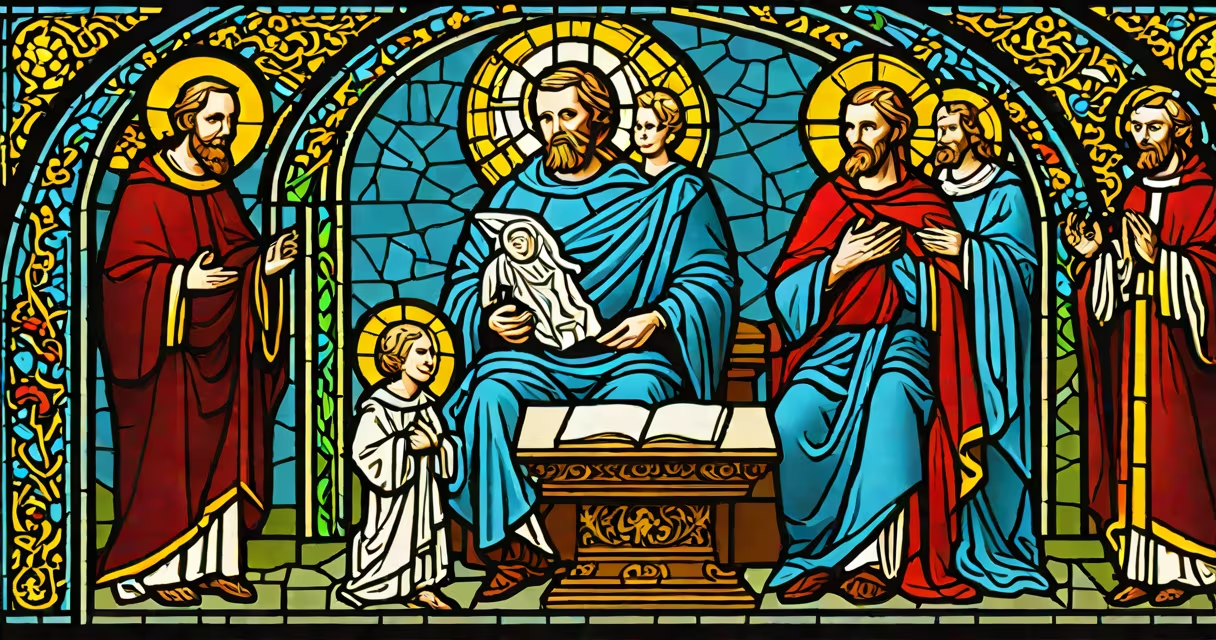
Catholics believe the Trinity is one God in three distinct, co-eternal persons: the Father, the Son (Jesus Christ), and the Holy Spirit. This doctrine holds that each person is fully God, yet there is only one divine nature shared among them. The belief is central to Catholic identity and grounded in Scripture and centuries of theological reflection.
The Trinity is not a division of God into parts but a mystery of relational unity. The Father is the source of divinity, the Son is eternally begotten of the Father, and the Holy Spirit proceeds from both. These relationships are not temporal or hierarchical in rank but eternal and equal. The Catechism of the Catholic Church states: "The Trinity is one God in three Persons" (CCC 234).
This understanding emerged from early Church councils, especially the Council of Nicaea (325 AD) and the Council of Constantinople (381 AD), which affirmed that Jesus is "begotten, not made, of the same substance as the Father." These decrees rejected Arianism, which claimed Christ was created and therefore subordinate to God the Father.
Catholic theology describes the Trinity as a communion of love. The Father sends the Son, the Son obeys and reveals the Father, and the Holy Spirit proceeds from both and unites believers to God. This changing relationship is not static-it reflects God's inner life as relational and self-giving.
Scripture supports this structure. John 14:16-17 says, "I will ask the Father, and he will give you another Advocate to help you and be with you forever-the Spirit of truth." Here, Jesus prays to the Father, promises the Holy Spirit, and positions Himself as the one who sends the Spirit. This triune action appears throughout the Gospels.
At baptism, Catholics are immersed in water and anointed with oil while the minister says, "I baptize you in the name of the Father, and of the Son, and of the Holy Spirit." This Trinitarian formula is derived from Matthew 28:19, which Jesus gives as the model for Christian initiation. The act of baptism thus marks entry into the life of the Trinity.
The Trinity is not three gods or three aspects of one god. It is not a metaphor or a symbol. Catholics affirm that each person of the Trinity is fully divine-eternal, omnipotent, omniscient, and immutable. The Father is God, the Son is God, the Holy Spirit is God. Yet they are not three separate beings; they are one God.
Think of it this way: a single human being can have multiple roles-parent, worker, friend-but remains one person. The Trinity is not like a team of three people sharing one job. Instead, it is like a single reality expressed through three distinct modes of being. As St. Augustine wrote, "The Trinity is not three gods, nor one God in three forms, but one God in three Persons."
A common misunderstanding is that the Trinity is a later invention. But the New Proof contains Trinitarian language. For example, in Matthew 28:19, Jesus commands disciples to baptize "in the name of the Father and of the Son and of the Holy Spirit." Paul uses Trinitarian formulas in 2 Corinthians 13:14: "The grace of the Lord Jesus Christ, and the love of God, and the fellowship of the Holy Spirit be with you all."
| Person | Role in the Trinity | Key Scripture |
|---|---|---|
| Father | Source of all creation; origin of the Son and Spirit | John 1:18 - "No one has seen God at any time. The only Son, who is at the Father's side, has made him known." |
| Son (Jesus) | Incarnate Word; redeemer of humanity; eternal begotten of the Father | Colossians 1:15-17 - "He is the image of the invisible God... in him all things were created." |
| Holy Spirit | Presence of God in the world; sanctifier and guide | Acts 2:3-4 - "And they were all filled with the Holy Spirit..." |
The Trinity shapes every aspect of Catholic worship. The Mass begins with the Sign of the Cross: "In the name of the Father, and of the Son, and of the Holy Spirit." The Eucharist is celebrated in the presence of the Triune God. Prayers often invoke all three Persons-"O God, Father, Son, and Holy Spirit."
Devotions like the Rosary include meditations on the mysteries of Christ's life, death, and resurrection-all rooted in the work of the Trinity. The Holy Spirit guides the Church, the Son reconciles humanity, and the Father calls all people to salvation.
When Catholics pray, they do so in the name of the Trinity. The Our Father begins with "Our Father," addresses the Son's mission, and ends with a plea for the Holy Spirit's guidance. This prayer reflects the Trinitarian structure of Christian life.
Many assume the Trinity is a philosophical concept invented by theologians. But it is drawn from biblical revelation. The term "Trinity" itself wasn't used until the 2nd century, but the idea is present in the Gospels and Epistles. Early Christians didn't debate whether God was one or three-they wrestled with how God could be both one and three.
Another misconception is that the Trinity implies a hierarchy. The Catholic Church explicitly rejects subordinationism-the idea that one Person is less than another. All three Persons are equal in power, glory, and eternity. The Catechism states: "The three Persons are inseparable in their inner life and in their external mission" (CCC 262).
Some think the Trinity is a contradiction. But Catholics don't claim to fully understand it. The Church teaches that the Trinity is a mystery-something beyond complete human comprehension. As Pope Benedict XVI wrote in *Deus Caritas Est*: "God is love, and in His very being He is a communion of persons."
I once attended a parish retreat where a young man asked, "If God is three, why do we say 'God'?" I responded: "Because we're not talking about three gods-we're talking about one God who exists in three ways of being." He nodded slowly. That moment reminded me that the Trinity isn't a puzzle to solve-it's a reality to live within.
The Trinity is not a trinity of roles. The Father is not "God the Creator," the Son "God the Redeemer," and the Holy Spirit "God the Sanctifier"-not because those roles aren't true, but because they reduce the Persons to functions. Each Person is fully God in every role.
It is also not a metaphor. While analogies like water (liquid, solid, vapor) or a family are sometimes used, they fail. Water changes state; the Persons of the Trinity do not change. They are eternally who they are.
Finally, the Trinity is not a political or social model. The Church does not teach that the Trinity reflects human governance or gender roles. The Persons are not male or female in the way humans are. The language of "Father" and "Son" is relational, not biological.
Understanding what Catholics believe about the Trinity requires accepting that God is relational by nature. The Trinity is not a doctrine added to Christianity-it is the heart of it. The belief that God is one in three persons defines Catholic worship, ethics, and spiritual life. It is not a theory. It is a lived reality.