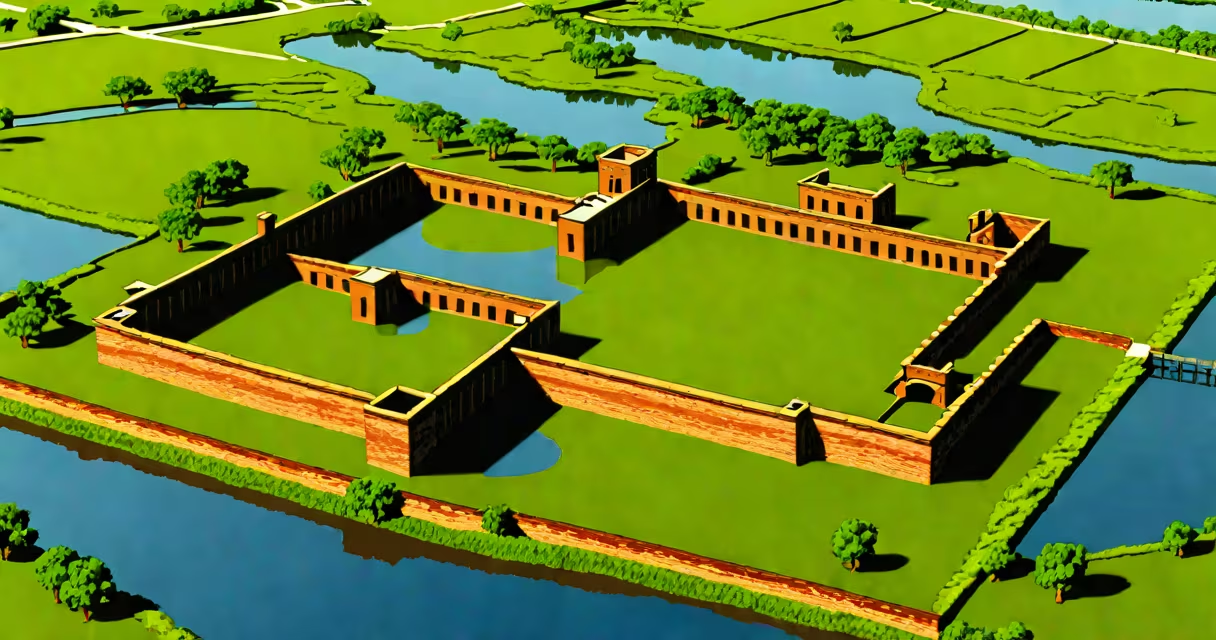
Fort Pulaski National Monument is a preserved 19th-century coastal defense fortress located on Cockspur Island, Georgia, just south of Savannah. It was constructed between 1829 and 1847 using over 10 million bricks and served as a key defensive installation during the American Civil War. The fort is best known for being the site of the first successful use of rifled artillery against a masonry fort during the war, leading to its surrender in April 1864.
The fort was designed by the U.S. Army Corps of Engineers under General Simon Bernard, who based its layout on European bastion fort principles. Its thick, curved brick walls were meant to deflect cannon fire and withstand prolonged bombardment. The structure sits on a low-lying island surrounded by tidal marshes and saltwater channels, making access difficult without boats. The site's location controlled the entrance to the Savannah River, a important waterway for trade and military movement.
During the Civil War, Confederate forces occupied Fort Pulaski after Georgia seceded in 1861. They reinforced it with cannons and troops, expecting it to resist Union naval attacks. However, in April 1864, Union forces under Brigadier General Quincy A. Gillmore launched a siege using newly developed rifled Parrott guns. These weapons fired explosive shells with greater accuracy and range than traditional smoothbore cannons. After 30 hours of sustained fire, the fort's walls began to crumble. On April 11, 1864, Confederate commander Colonel Charles H. Olmstead surrendered the garrison, marking the first time a masonry fort had fallen to rifled artillery.
Union forces positioned their rifled guns on nearby Tybee Island and on landward batteries. The Parrott rifles fired 100-pound projectiles at a velocity of around 1,700 feet per second. These shells struck the fort's walls at angles that caused massive spalling-chunks of brick and mortar to fly off. The impact weakened internal structural supports, creating gaps through which soldiers could enter.
By the third day of bombardment, the fort's eastern wall had collapsed in multiple places. Engineers estimated that over 300 rounds were fired into the fort's perimeter. The Confederates had no effective countermeasure. Their smoothbore cannons could not reach the Union positions at long range, and their ammunition supply was limited. The decision to surrender came after a reconnaissance patrol confirmed that the enemy had breached the inner defenses.
After the surrender, Union troops occupied the fort until 1865. It remained largely intact, though some interior structures were damaged. The U.S. government took control of the site in 1946 and designated it a National Monument under the National Park Service. Today, visitors walk the same ramparts where soldiers stood during the siege, see the original cannons, and examine the scars left by cannonballs.
Fort Pulaski's primary construction material is brick-over 10 million hand-molded bricks laid in a complex pattern to absorb shock. The walls average 12 feet thick at the base and taper to 6 feet at the top. They rise 30 feet above ground level and include 15-foot-deep ditches filled with water during wartime.
The fort contains several distinct functional zones:
Unlike earlier forts built with stone or earthworks, Fort Pulaski's reliance on brick reflected advances in masonry engineering. However, the siege proved that even the most durable masonry couldn't withstand high-velocity projectiles. This event marked a turning point in military architecture worldwide.
Today, Fort Pulaski National Monument serves as a living classroom for Civil War history, military technology, and preservation science. The National Park Service manages the site, offering ranger-led tours, educational programs, and seasonal events such as reenactments of the 1864 siege.
Visitors can explore the fort's interior, climb the parapets, and stand in the gun emplacements. The park includes a visitor center with exhibits on the fort's construction, the siege, and the lives of soldiers and enslaved people who lived nearby. Over 150,000 people visit annually, drawn by the site's historical significance and scenic setting.
A lesser-known fact: the fort was never attacked by sea. All bombardment came from land-based positions. The Union used a combination of field artillery and mortars placed on elevated ground to achieve optimal firing angles. This strategy minimized risk to ships and allowed precise targeting of vulnerable wall sections.
Many assume the fort fell due to a direct hit or explosion. In reality, the collapse resulted from cumulative stress. The brick walls didn't explode-they cracked progressively under repeated impacts. The final breach occurred not from a single shell, but from hundreds of smaller hits that destabilized the mortar joints.
Another misconception is that the Confederate garrison fought to the last man. In fact, only 230 soldiers were stationed at the time. The surrender was negotiated quickly after the damage assessment. Colonel Olmstead offered terms based on humane treatment of prisoners and safe passage for wounded personnel.
Some believe the fort was abandoned after the war. Instead, it remained in federal service until 1946. The U.S. Army used it briefly during World War I for training and storage. After decades of neglect, Congress authorized its protection as a national monument under the Antiquities Act.
On April 10, 1864, Union forces deployed 12 Parrott rifles and 6 mortars. The Parrott guns fired 100-pound shells at a rate of 12 rounds per hour. Over 30 hours, they fired 1,480 rounds into the fort's eastern wall. The average impact force was 12,000 foot-pounds.
Engineers later measured the damage: 12 breaches in the wall, 8 of which were large enough to allow entry. The largest gap was 15 feet wide and 10 feet high. Internal chambers showed signs of structural failure, including collapsed ceilings and fractured floor joists.
Despite the destruction, the fort's foundation remained stable. Modern surveys show that 90% of the original brickwork is still intact. Restoration efforts focus on stabilizing cracks and preventing further erosion from saltwater exposure.
| Feature | Fort Pulaski | Fort Sumter (SC) | Fort McHenry (MD) |
|---|---|---|---|
| Construction Material | Brick (10M+ units) | Stone and brick | Stone and earthworks |
| Primary Defense Type | Masonry bastion | Masonry with casemates | Earth and stone redoubt |
| First Major Engagement | Siege, April 1864 | Bombardment, April 1861 | Battle, September 1814 |
| Outcome | Surrender after 30 hours | Abandoned after 34 hours | Repelled British attack |
| Modern Status | National Monument (1946) | National Historic Landmark | National Historical Park |
While Fort Sumter is better known for launching the Civil War, Fort Pulaski demonstrated the obsolescence of traditional masonry forts. The results of the siege influenced military planning in Europe and Asia, leading to the adoption of concrete and angled armor in new designs.
During a visit in 2022, I stood in the central courtyard and watched sunlight strike the remains of a collapsed wall. The sound of waves lapping at the moat echoed through the space. A ranger pointed out a 1-inch-wide crack in the brickwork-still visible after 150 years. That moment underscored how fragile history can be, yet how resilient preservation efforts can make it endure.
Fort Pulaski National Monument stands as a physical record of technological change, military strategy, and the enduring power of place. Its survival is not accidental-it is the result of deliberate stewardship, scientific conservation, and public interest. The fort continues to teach lessons about war, materials, and the human capacity to build-and to break.