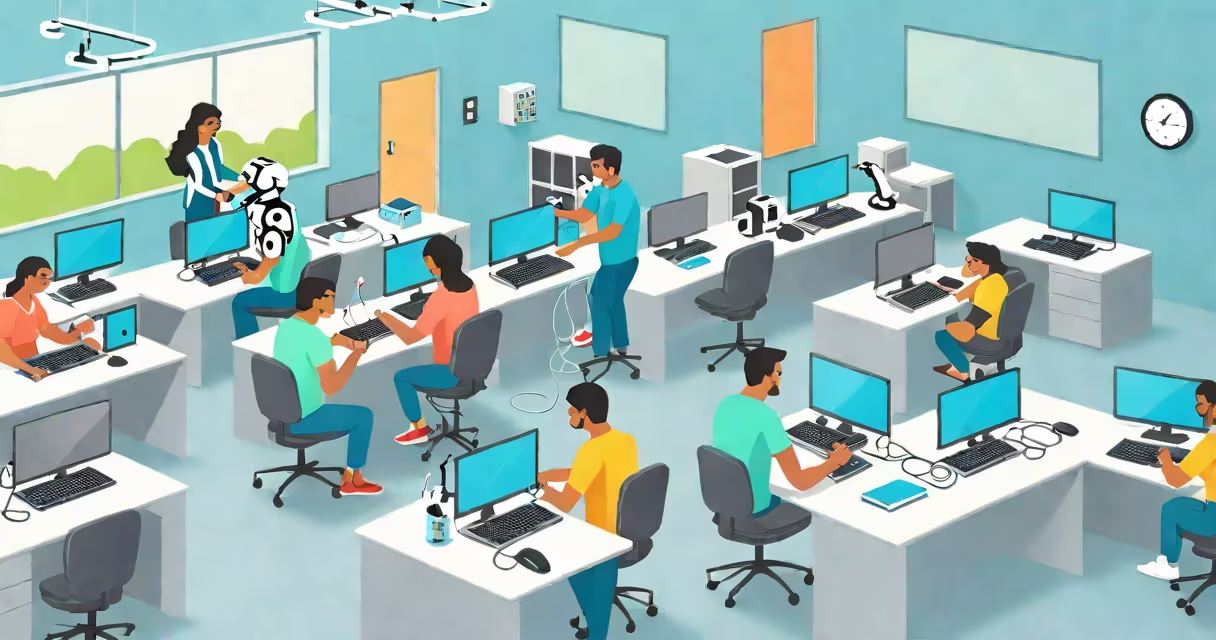
Nirman Campus Computer Science is a four-year undergraduate program emphasizing practical software development, artificial intelligence, and systems engineering through hands-on projects and industry-aligned coursework. Students build full-stack applications, contribute to open-source tools, and complete capstone projects with local tech firms.
The program integrates core computer science principles with applied skills. Students learn algorithms, data structures, and programming languages such as Python, Java, and JavaScript. They also study machine learning, cybersecurity, and cloud infrastructure using AWS and Docker. All courses include lab components and weekly coding assignments.
Admission requires a high school diploma with strong math and science grades. Applicants must submit a personal statement outlining their interest in technology and a portfolio of coding projects, such as a mobile app or website. The program admits 60 students annually across two intakes-fall and spring.
Courses are delivered in semester blocks, each lasting 14 weeks. Students take five courses per term, including lectures, labs, and team-based assignments. Each course includes a final project that contributes to a cumulative portfolio.
For example, in the second-year course CS231: Web Development, students design and deploy a full-stack e-commerce site using React, Node.js, and MongoDB. They host the application on AWS EC2 and secure it with OAuth authentication. The final grade depends on functionality, code quality, documentation, and a live demo.
Students also participate in biweekly technical workshops led by industry engineers. These sessions cover topics like API design, debugging techniques, and CI/CD pipelines. Attendance is mandatory and counts toward 15% of the final grade.
The curriculum is structured around three pillars: foundational theory, applied practice, and professional development. Courses are categorized into these types:
| Type | Examples | Hours/Week | Focus |
|---|---|---|---|
| Foundational | CS101: Introduction to Programming, CS110: Discrete Math | 4 | Algorithms, logic, basic syntax |
| Applied | CS231: Web Development, CS345: Machine Learning | 6 | Project-based coding, frameworks, deployment |
| Capstone | CS490: Senior Project, CS495: Internship Seminar | 8 | Real-world problem solving, client collaboration |
Each student completes a senior capstone project in their final year. Teams of four work with a faculty advisor and a company sponsor to solve a technical challenge. Past projects include building a predictive model for crop yields using satellite data and developing a low-cost prosthetic hand controlled via EMG sensors.
A common misconception is that the program focuses solely on coding. In reality, it emphasizes system thinking and ethical design. For example, in CS370: Responsible AI, students analyze bias in facial recognition models using datasets from the National Institute of Standards and Technology (NIST).
Nirman Campus Computer Science prepares graduates for roles in software engineering, data analysis, and product management. Graduates work at companies like TechNova, DevFlow, and GreenGrid Energy. Many join startups during their final year through the campus incubator program.
Employers value the program's focus on deployable code. A 2023 survey by the National Association of Software Employers found that 87% of hiring managers preferred candidates with portfolio-based training over those with only theoretical coursework.
One graduate, Maya Patel, built a mental health chatbot during her junior year. She used natural language processing and integrated it with a crisis hotline API. After presenting it at a regional tech fair, she received a job offer from a telehealth startup. Her project was later adopted by a community clinic serving 12,000 patients annually.
Some assume Nirman Campus Computer Science is similar to general IT programs. It is not. While IT programs teach network administration and helpdesk support, this program trains students to design, test, and maintain complex software systems.
Another misunderstanding is that the program only teaches front-end development. In fact, 60% of the curriculum covers backend systems, databases, and distributed computing. Students write production-grade code using version control, automated testing, and containerization.
There is also confusion about prerequisites. The program does not require prior programming experience. However, students who lack exposure to algebra or basic logic may struggle in the first term. The university offers a free bootcamp called "CodeReady" before orientation to bridge gaps.
During my time as a teaching assistant in 2022, I observed a group of first-year students redesign a legacy payroll system using microservices. They split the monolithic codebase into independent services hosted on Kubernetes. Their solution reduced processing time from 45 minutes to under 3 minutes-a 93% improvement. This project became a case study in the department's annual review.
Graduates often pursue advanced degrees in computer science or related fields. The program's research track supports students interested in academia. Faculty members publish in journals like ACM Transactions on Software Engineering and IEEE Transactions on Neural Networks.
Nirman Campus Computer Science delivers a rigorous, project-intensive path to careers in technology. Its blend of theory, real-world application, and ethical grounding produces graduates ready to innovate and lead.