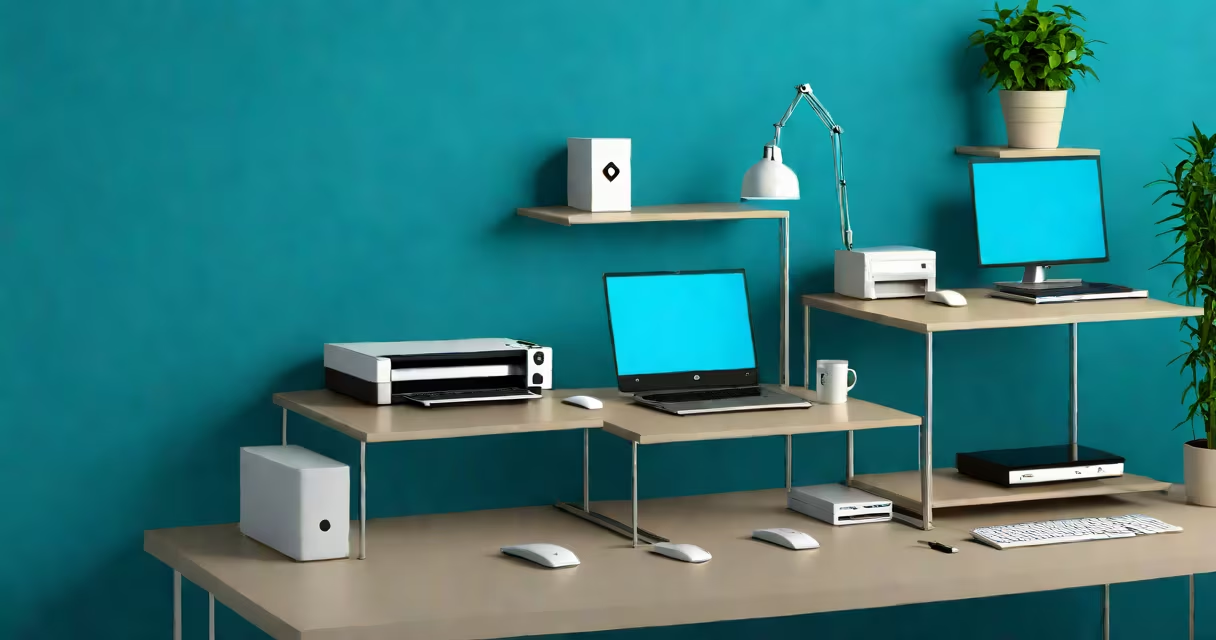
Hewlett Packard (HP) designs and manufactures computers, printers, servers, and enterprise software used by millions worldwide. The company operates under two primary brands: HP Inc., which focuses on consumer and business hardware, and Hewlett Packard Enterprise (HPE), which delivers data center infrastructure and cloud solutions.
HP Inc. produces laptops, desktops, monitors, and printers sold under the HP brand. These devices serve home users, students, professionals, and small-to-medium enterprises. HP's product lineup includes the Spectre, Envy, and Pavilion lines of laptops, along with the EliteBook series for business users. Its printers range from compact inkjet models like the HP OfficeJet Pro to high-volume laser systems such as the HP LaserJet MFP series.
Hewlett Packard Enterprise (HPE) develops large-scale IT infrastructure. This includes servers like the HPE ProLiant line, storage systems such as the HPE Nimble Storage range, and networking gear. HPE also offers hybrid cloud platforms, including HPE GreenLake, which enables customers to run workloads on-premises or in public clouds through a consumption-based model. The company supports industries ranging from healthcare to finance with secure, scalable systems.
HP's hardware relies on integrated components from global suppliers. A typical HP laptop combines Intel or AMD processors, DDR4/DDR5 memory, solid-state drives (SSDs), and discrete graphics cards. These parts connect via a motherboard designed for power efficiency and thermal management. For example, the HP Spectre x360 uses a 13th-gen Intel Core i7 chip, 16GB RAM, and a 1TB SSD, enabling fast boot times and sustained performance during video editing.
Printers function through a combination of mechanical precision and embedded firmware. Inkjet models like the HP Envy 6055 use piezoelectric nozzles to eject tiny droplets of ink onto paper. The printer's internal microcontroller adjusts nozzle timing based on paper thickness and print quality settings. Laser printers, such as the HP LaserJet Pro M404dn, use a rotating drum charged with static electricity to attract toner particles, which are then fused to paper using heat and pressure.
Enterprise systems from HPE require specialized configurations. An HPE ProLiant DL380 Gen11 server, for instance, supports dual Intel Xeon Scalable processors, up to 2TB of RAM, and multiple NVMe SSDs. It runs on HPE OneView software, which automates server provisioning, firmware updates, and health monitoring. These systems often operate in data centers with redundant power and cooling to ensure uptime above 99.99%.
HP's offerings fall into four core categories: personal computing, printing, enterprise infrastructure, and software services.
| Product Type | Examples | Primary Users | Use Cases |
|---|---|---|---|
| Consumer Laptops | HP Pavilion, HP Envy | Students, remote workers | Online classes, document creation, web browsing |
| Business Laptops | HP EliteBook, HP ZBook | Corporate employees, engineers | Secure data handling, CAD design, video conferencing |
| Printers | HP OfficeJet Pro, HP LaserJet | Home offices, schools, small businesses | Document printing, scanning, copying |
| Servers & Storage | HPE ProLiant, HPE Nimble Storage | IT departments, cloud providers | Data hosting, backup, virtualization |
Each category serves distinct needs. For example, HP's EliteBook 840 G10 features a TPM 2.0 chip, fingerprint reader, and encrypted SSD-essential for protecting sensitive corporate data. In contrast, the HP OfficeJet 5255 is optimized for low-cost color printing with automatic duplexing, ideal for households printing school assignments or family photos.
Many assume HP only makes printers. While HP was founded in 1939 as a company focused on electronic test equipment, it became widely known for inkjet printers in the 1990s. However, HP has long produced computing devices. The HP 2000 series laptop launched in 2010, and the HP EliteBook line began in 2007. By 2023, HP Inc. generated $56 billion in revenue, with 60% from personal computing and 25% from printing.
Another confusion arises between HP Inc. and Hewlett Packard Enterprise. They are legally and financially separate entities. HP Inc. handles consumer electronics and business PCs. HPE manages enterprise IT systems. In 2015, the companies split after decades of operating as one entity. HPE continues to supply infrastructure for Fortune 500 firms, while HP Inc. sells devices through retailers like Best Buy and Amazon.
A lesser-known fact: HP developed the first commercially successful inkjet printer in 1988-the HP ThinkJet. It used a print head with 64 nozzles and could produce 300 dpi resolution. This innovation laid the foundation for modern inkjet technology. Today, HP's Instant Ink subscription service automatically sends replacement cartridges when ink levels drop below 10%, reducing waste and ensuring uninterrupted printing.
In 2022, the Los Angeles Unified School District deployed 12,000 HP Chromebooks to students in grades 6-12. These devices ran Chrome OS, connected to district Wi-Fi, and accessed Google Workspace for Education. Teachers used HP's built-in security features-such as hardware-based encryption and automatic OS updates-to prevent unauthorized access. Over one semester, the district reported a 40% reduction in device downtime compared to previous years.
For printing, the district used HP LaserJet MFP M430f printers in libraries and classrooms. These units supported mobile printing via the HP Smart app, allowing students to send documents from phones or tablets. The system logged usage data, helping administrators track printer efficiency. Maintenance costs dropped by 22% due to predictive alerts from HP's JetAdvantage Management Console.
During a network outage in October 2022, the district's IT team restored connectivity within 90 minutes using HPE's Aruba networking gear. The Aruba Instant Access Point handled 800 concurrent users and auto-recovered from a failed power supply. This resilience demonstrated how HP's enterprise tools support mission-critical operations.
Understanding what Hewlett Packard makes requires separating HP Inc. from HPE. HP Inc. delivers everyday devices-laptops, printers, monitors-that power individual workflows. HPE builds the underlying systems that enable large organizations to scale, secure, and automate their digital operations. Both branches contribute to HP's legacy as a leader in technology innovation.