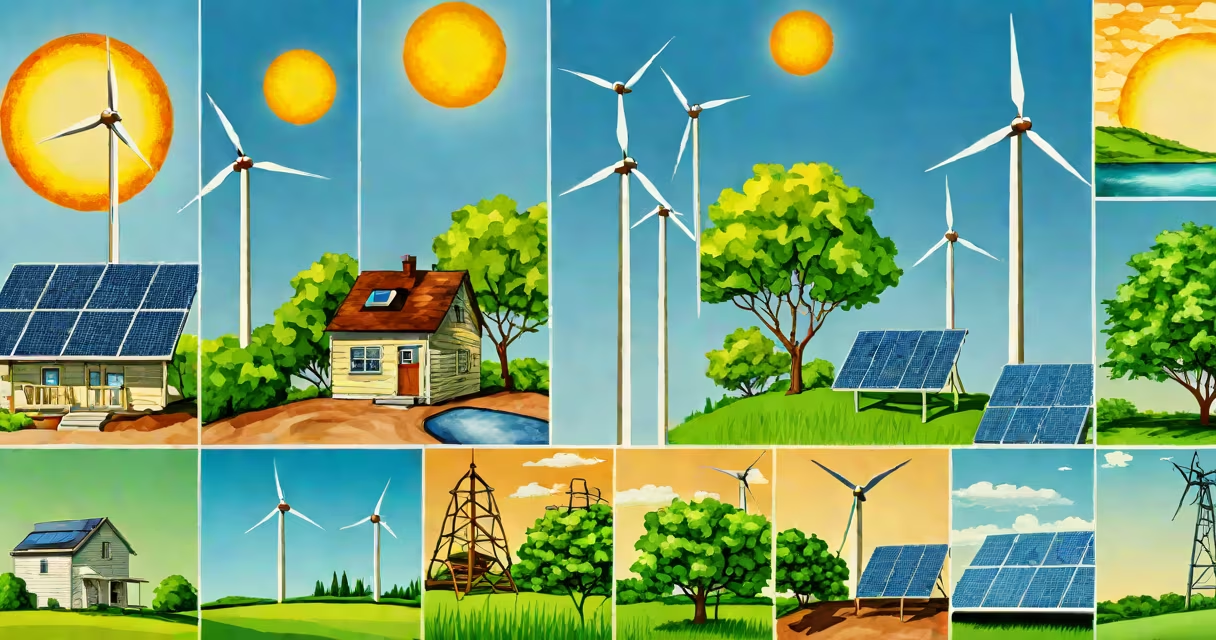
A renewable resource is a natural resource that replenishes itself over time at a rate equal to or faster than its consumption. Solar energy, wind, biomass, and hydropower meet this standard. Fossil fuels like coal, oil, and natural gas do not.
Renewable resources regenerate within human timescales-years, decades, or centuries. Non-renewable resources take millions of years to form. Once extracted and burned, fossil fuels vanish permanently. The sun, wind, and growing plants renew daily or seasonally.
The U.S. Energy Information Administration defines renewable energy as "energy derived from natural sources that are replenished on a human timescale." This includes solar, wind, geothermal, biomass, and hydropower. These sources supply 20% of U.S. energy use as of 2023, according to the EIA's Annual Energy Review.
Renewable resources rely on continuous natural processes. Solar panels convert sunlight into electricity via photovoltaic cells. Wind turbines capture kinetic energy from moving air. Hydropower uses flowing water to spin generators. Biomass burns organic matter-wood, crop waste, or algae-to produce heat or electricity.
These systems don't deplete their inputs. Sunlight hits Earth every day. Winds circulate due to temperature differences. Rivers flow from precipitation. Plants grow back after harvest. The cycle repeats without interruption.
By contrast, fossil fuels formed from buried organic material compressed over millions of years. Extraction rates far exceed formation rates. Global oil reserves are estimated to last 50 years at current usage, according to BP's Statistical Review of World Energy 2023.
Renewables fall into five main categories. Each has distinct sources, technologies, and limitations.
| Type | Source | Replenishment Time | Example Use |
|---|---|---|---|
| Solar | Direct sunlight | Continuous (daily) | Electricity via rooftop panels |
| Wind | Atmospheric movement | Constant (hourly) | Large-scale power farms |
| Biomass | Plants, animal waste, wood | Seasonal to annual | Heating, biofuels, electricity |
| Hydropower | Flowing rivers, dams | Annual (rain cycles) | Grid electricity in mountainous regions |
| Geothermal | Earth's internal heat | Constant (deep underground) | Heating buildings, electricity |
Each type varies in efficiency and environmental impact. Solar panels generate electricity only during daylight. Wind depends on weather patterns. Biomass combustion releases carbon dioxide-but only as much as the plants absorbed while growing, making it carbon-neutral over time.
Hydropower provides stable baseload power but can disrupt river ecosystems. Geothermal requires specific geological conditions and is limited to tectonic zones like Iceland or California's geothermal fields.
Many assume all energy sources labeled "green" are renewable. That's false. Some biofuels come from crops grown on cleared rainforest land, reducing biodiversity and increasing emissions. The European Commission's 2021 report on sustainability criteria found that 12% of EU biofuel imports came from deforested areas.
Another error: thinking "renewable" means "zero-emission." While most renewables emit little during operation, manufacturing and installation have footprints. A solar panel's production emits 40-60 grams of CO₂ per kilowatt-hour over its lifetime, according to the National Renewable Energy Laboratory (NREL).
Even more misleading is calling natural gas "clean." It's not renewable. Though burning gas produces fewer emissions than coal, it still releases methane-a greenhouse gas 80 times more potent than CO₂ over 20 years. The Intergovernmental Panel on Climate Change (IPCC) reports that global methane emissions from fossil fuel extraction rose 15% between 2000 and 2020.
In 2022, Denmark generated 52% of its electricity from wind and solar. The country operates offshore wind farms like Horns Rev 3, which supplies power to 400,000 homes annually. This exceeds its domestic demand and exports surplus energy to Germany and Sweden.
India's Kutch region hosts one of the largest solar parks in Asia. The 1,000-megawatt facility covers 2,500 acres and powers over 1 million homes. It uses tracking panels that follow the sun, boosting output by 25% compared to fixed arrays.
However, natural gas remains a major energy source. In 2023, it supplied 38% of U.S. electricity generation. But it's not renewable. Gas is extracted through fracking, a process that consumes groundwater and triggers small earthquakes in shale-rich areas like Texas and Pennsylvania.
I once visited a biomass plant in rural Oregon. Workers fed chipped wood and agricultural residue into a boiler. The steam turned turbines. The facility ran continuously, but only because nearby forests were managed sustainably. When the supply chain broke during a drought, output dropped 40%. That showed how even renewable systems depend on consistent input.
Among common options, solar, wind, biomass, and hydropower are renewable. Coal, oil, and natural gas are not. The key difference lies in regeneration speed relative to human use.
For example, a single solar panel generates electricity for 25-30 years. The sun will shine for billions of years. That makes solar energy renewable. A barrel of oil takes 10 million years to form. Extracting it faster than it forms makes oil non-renewable.
When evaluating resources, ask: Does it renew faster than we consume it? If yes, it qualifies. If no, it doesn't. This rule applies regardless of branding or marketing claims.