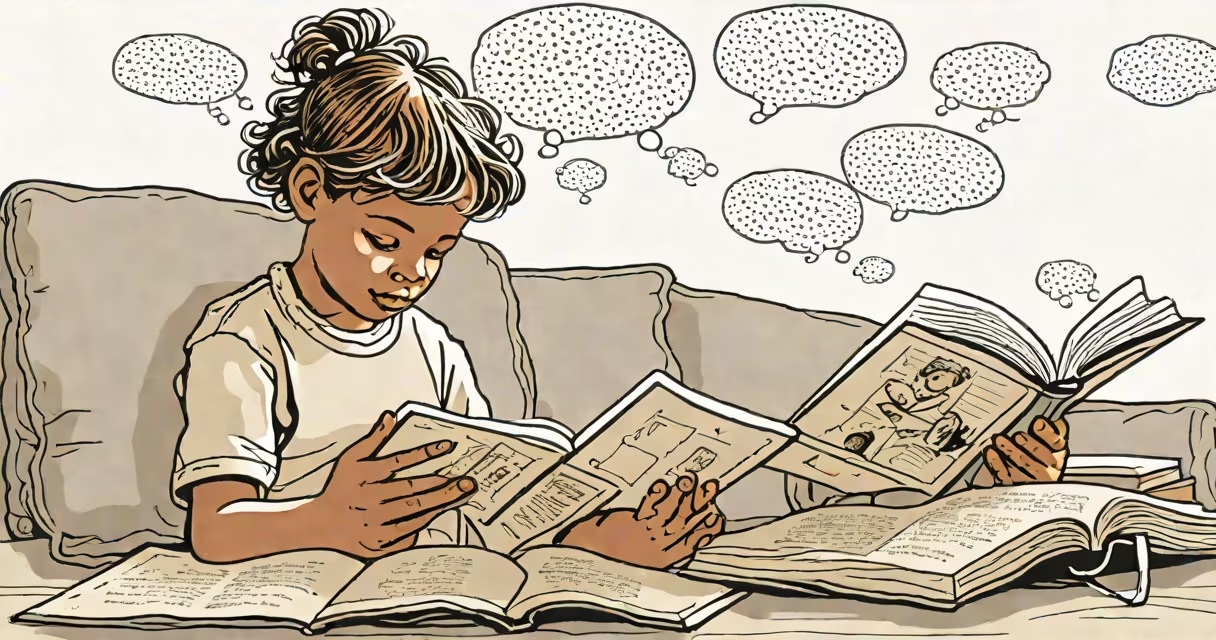
Inference is when you figure something out by using clues in a story or picture, even if it's not said directly. You use what you already know and what's written or shown to guess the missing parts.
When you read a book and see a character frowning, holding a crumpled letter, and walking away quickly, you don't hear them say "I'm sad." But you can infer they're upset because of their body language and the situation. That's inference.
Teachers often call this "reading between the lines." It's not guessing randomly-it's using evidence. For example, if a story says, "The dog barked loudly at 3 a.m.," and the house was quiet before, you can infer someone might have woken up.
Inference relies on combining known facts with details from a text or image. You start with what's visible or stated, then think about what makes sense based on real-world knowledge.
For instance, if a story says, "She packed her bag, checked the weather app, and wore boots," you can infer she's going hiking. You didn't read "she's going hiking," but the clues point to that conclusion.
According to the National Reading Panel (2000), inference is a core skill in reading comprehension. Students who practice inference understand texts better, especially when authors don't spell everything out.
There are three main kinds of clues that help kids make inferences:
| Type | What It Is | Example |
|---|---|---|
| Textual clues | Words or sentences directly in the story | "He looked at his watch and sighed." → He's late or stressed. |
| Visual clues | Images, facial expressions, or actions in pictures | A boy covering his ears during thunder → He's afraid of storms. |
| Contextual clues | Real-world knowledge and common experiences | "The classroom was empty, and the teacher's desk had papers everywhere." → Class must be over. |
Children often mix up inference with prediction. Prediction is guessing what happens next. Inference is understanding what already happened or what's true now, based on evidence.
For example, if a story says, "The door creaked open slowly," a prediction might be, "Someone is coming in." An inference from the same line could be, "The room hasn't been used in a while-dust is on the floor."
Teachers use inference to test whether students truly understand what they read. A student who can infer the mood of a scene shows deeper thinking than one who only repeats facts.
One study from the University of Michigan (2016) found that children who were taught inference strategies scored 23% higher on reading tests than those who weren't. The difference came from being able to connect ideas, not just recall them.
I once watched a third grader read a short story about a girl who kept checking her phone during dinner. She said, "She's worried about her friend." When asked how she knew, she pointed to the line: "She pressed the send button twice." That's inference-not just observation, but reasoning.
Some kids think inference means making up anything they want. But it's not imagination-it's logic. You can't infer "the cat flew" if the story says "the cat sat on the windowsill." That breaks reality.
Another mistake is skipping clues. A child might say, "The boy is happy" because he's smiling, but ignore the detail that he's holding a broken toy. The full picture suggests sadness, not joy.
Always ask: "What do I see or read?" Then "What do I know from life?" Finally, "What makes sense?" This three-step process keeps inferences grounded.
Try this at home: Show a picture of a child standing in front of a closed door, holding a backpack and looking nervous. Ask:
Guide them to list clues: backpack = going somewhere, closed door = unknown, nervous face = fear or worry. Then ask, "Can you infer why they're scared?"
After trying it, you'll see how inference turns small details into big insights. It's not magic-it's thinking.