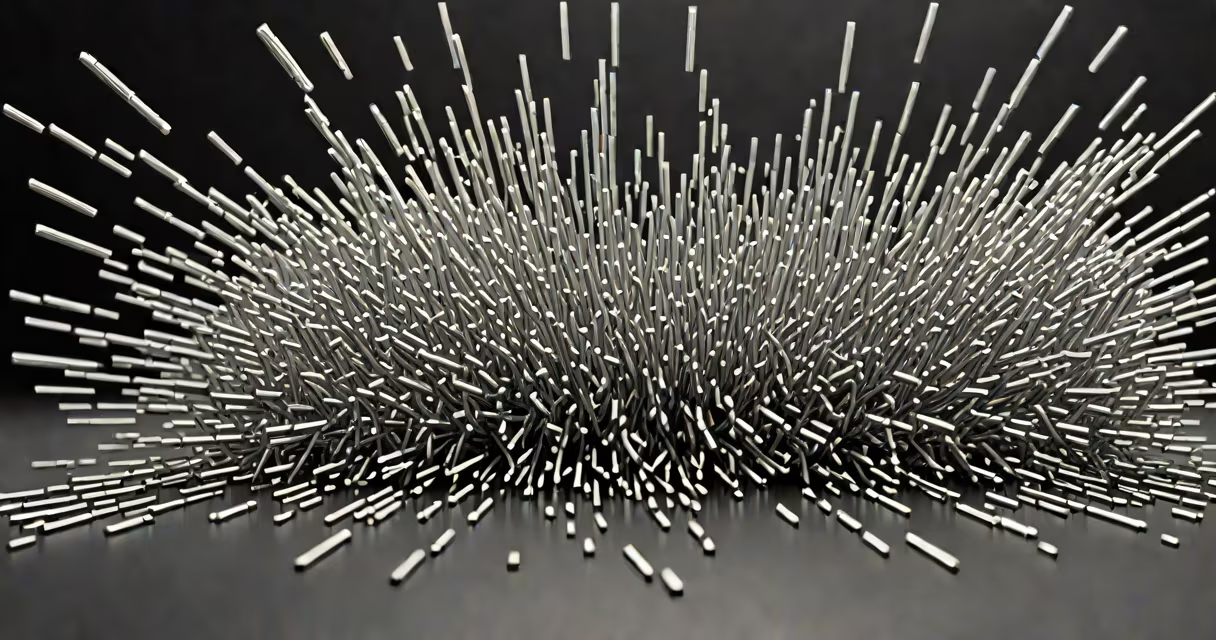
Magnetic force is the interaction between moving electric charges or magnetic materials, arising from electromagnetic fields. It acts perpendicular to both the velocity of a charged particle and the direction of the magnetic field, influencing motion without direct contact.
This force is not a standalone phenomenon-it emerges from the interplay of electric charge, motion, and magnetic fields. Unlike gravity, which acts on mass, magnetic force acts only on moving charges or magnetic dipoles. It underpins technologies from compasses to particle accelerators and shapes how electrons behave in atoms.
The concept traces to early observations of lodestones-naturally magnetized rocks attracting iron. Modern understanding began with Hans Christian Ørsted's 1820 experiment showing that an electric current deflects a compass needle. This linked electricity and magnetism, later formalized by James Clerk Maxwell's equations.
Magnetic force results from the motion of electric charges. A stationary charge experiences no magnetic force. But when a charged particle moves through a magnetic field, it feels a force perpendicular to both its velocity and the field direction.
Mathematically, the Lorentz force law defines this: F = q(v × B), where F is the force vector, q is the charge, v is the velocity vector, and B is the magnetic field vector. The cross product (×) ensures the force is always at a right angle to motion and field.
For example, in a cathode ray tube (CRT), electrons fired toward a screen experience deflection by magnetic fields. Adjusting the field strength changes the path curvature-used in old TVs and oscilloscopes to steer electron beams.
Magnetic force arises from two distinct sources: intrinsic spin of elementary particles and macroscopic currents. Both generate magnetic moments, which interact with external fields.
There are two primary manifestations:
| Type | Source | Example | Strength Scale |
|---|---|---|---|
| Force on moving charges | Electric current or free-moving electrons | Electron beam in a cyclotron | Nanonewtons to micro-newtons |
| Force on magnetic dipoles | Permanent magnets or aligned atomic spins | Neodymium magnet lifting steel paperclips | Millinewtons to newtons |
While both types involve field interactions, the force on moving charges depends on speed and direction. The force on a dipole depends on field gradient-stronger where the field changes rapidly. This explains why magnets attract metal objects more strongly near their poles.
A common misconception is that magnetic force can do work. It cannot. Because the force is always perpendicular to motion, it changes direction but not speed. Kinetic energy remains constant-only trajectory shifts. This differs from electric forces, which can accelerate particles.
Magnetic force enables critical functions in modern infrastructure. Electric motors convert electrical energy into mechanical rotation using magnetic fields acting on current-carrying wires. The force on each wire segment generates torque, turning the rotor.
Medical imaging relies heavily on magnetic force. MRI scanners use useful superconducting magnets (typically 1.5 to 3 tesla) to align hydrogen nuclei in the body. Radio waves then perturb this alignment, and the returning signals are processed into images. Without precise control of magnetic forces, such detailed internal views would be impossible.
Earth itself acts as a giant magnet. Its core, composed of molten iron and nickel, generates a changing magnetic field via the geodynamo effect. This field deflects solar wind particles, protecting the atmosphere. Without this force, cosmic radiation would strip away water vapor and hinder life's development.
People often confuse magnetic force with gravitational or electrostatic force. Gravity acts on mass. Electrostatic force acts on any charge, regardless of motion. Magnetic force requires motion and is directional-always perpendicular to movement.
Another error: assuming magnets attract all metals. Only ferromagnetic materials-iron, nickel, cobalt, and some alloys-respond strongly. Aluminum, copper, and gold show weak diamagnetic responses. A fridge magnet won't stick to aluminum foil.
Even experts misattribute the origin of magnetic fields. The field around a current-carrying wire isn't due to "magnetic particles"-it's generated by the flow of electrons. This was confirmed by Ampère's circuital law, verified in lab settings with precision measurements.
I once observed a classroom demo where students used a handheld coil and compass to map field lines around a wire. When current flowed, the compass needle rotated 90 degrees-clear evidence of circular magnetic fields. The demonstration showed that force direction follows the right-hand rule: thumb points in current direction, fingers curl in field direction.
Magnetic force depends on the observer's frame of reference. What appears as a pure magnetic force in one frame may include electric components in another. This insight stems from Einstein's special relativity, which unifies electric and magnetic phenomena.
For example, a stationary charge near a current-carrying wire feels no magnetic force. But if the observer moves alongside the charge, they see the wire's positive ions as contracted and negative electrons as less dense-creating a net electric field. The force now appears electric, not magnetic. The underlying physics is consistent; only the interpretation changes.
This relativistic connection shows that magnetism isn't a separate entity-it's a consequence of how space and time structure electromagnetic interactions.
Magnetic force is the influence exerted by magnetic fields on moving electric charges or magnetic materials. It acts perpendicularly to motion, cannot change kinetic energy, and arises from charge motion or intrinsic spin. It powers motors, enables medical imaging, and protects planets. Understanding it requires distinguishing it from related forces and recognizing its dependence on relative motion.