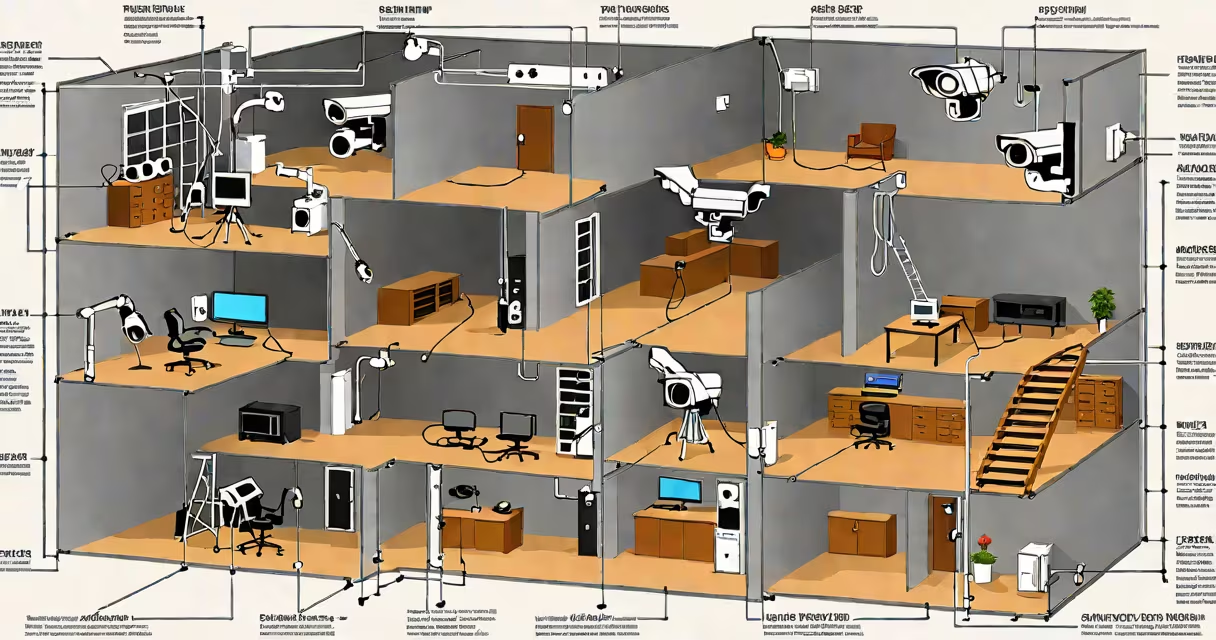
The best security camera system delivers clear video, consistent recording, remote access, and resilience against environmental damage. It balances performance, ease of use, and value without compromising privacy or reliability. For most homes, this means a wired or wireless network camera with 1080p or higher resolution, night vision, motion detection, and cloud or local storage.
Security camera systems function by capturing visual data through lenses and sensors, then transmitting it to a recorder or cloud service. Most modern systems use IP (Internet Protocol) cameras connected via Wi-Fi or Ethernet. These devices send video feeds to a central hub, smartphone app, or web portal. Users can view live streams, review recordings, and receive alerts when motion is detected. Systems vary in complexity-from single cameras to multi-point networks with AI-powered analytics.
Key components include the camera unit, power supply, storage method (local SD card, NVR, or cloud), and software interface. Wired systems offer stable connections and better bandwidth for high-quality video. Wireless models provide easier installation but depend on Wi-Fi strength and battery life. Hybrid systems combine both approaches for flexibility.
When motion is detected, the camera activates and begins recording. The system processes the event using onboard or cloud-based algorithms. If enabled, it sends a push notification to your phone. Video is stored either locally on a hard drive or remotely via subscription services. Some systems support facial recognition or object classification-distinguishing between people, animals, and vehicles.
For example, a Ring Stick Up Cam Pro detects movement within a 10-meter range. It records 1080p video with infrared night vision and streams live footage to a mobile app. When someone walks near the door, the system triggers an alert, plays a two-way audio message, and saves the clip to the cloud. You can review it later or share it with authorities.
Advanced systems integrate with smart home platforms like Amazon Alexa or Google Assistant. Saying "Show me the front door" pulls up the live feed on a compatible screen. This integration increases usability but requires careful configuration to avoid false triggers.
Security camera systems fall into three main categories based on deployment and control:
| Type | Best For | Pros | Cons |
|---|---|---|---|
| DIY Wireless | Homeowners who want quick setup and no contracts | Easy install, app control, no wiring, affordable entry points | Dependent on Wi-Fi, limited storage options, potential signal interference |
| Professional Monitored | Businesses or homes needing 24/7 response and legal evidence | Always-on monitoring, emergency dispatch, detailed logs, compliance with insurance standards | Higher monthly cost, long-term contracts, less user control |
| Hybrid (Wired + Cloud) | Users wanting reliability and scalability | Stable connection, high-quality video, flexible storage, supports AI analysis | Installation complexity, higher upfront cost, needs dedicated space for NVR |
Not all systems offer the same level of detail. A basic model may record only when motion is detected, while advanced ones use AI to filter out false alarms caused by trees or passing cars. The Arlo Pro 5 uses machine learning to identify human shapes and reduce false notifications by up to 70%, according to a 2023 test by Consumer Reports.
A lesser-known factor affecting performance is frame rate. Most consumer systems operate at 15 frames per second (fps), which is sufficient for general monitoring. However, for tracking fast-moving objects-like a vehicle speeding past a driveway-30 fps provides smoother playback and clearer identification. The Reolink Argus 4 offers 30 fps at 1080p, making it ideal for high-traffic zones.
Many assume that higher megapixels mean better quality. While 4K resolution captures more detail, it also demands more bandwidth and storage. A 4K camera in low light may produce blurry images due to sensor limitations. The best system prioritizes changing range and low-light sensitivity over raw pixel count.
Another mistake is believing that all cloud storage is secure. Free tiers often store videos in unencrypted form and may retain data indefinitely. The Federal Trade Commission warns that some services sell anonymized viewing patterns to advertisers. Always read the privacy policy and opt for providers with end-to-end encryption, such as Google Nest Aware or Arlo Secure.
I once installed a DIY system for a client in a rural area with weak internet. The initial setup used a 720p camera with cloud backup. After two weeks, the feed dropped during storms. Switching to a wired system with local NVR storage eliminated dropouts. The client reported feeling safer knowing recordings were preserved even during outages.
Start by defining your goals. Are you protecting a front entrance, a backyard, or a business perimeter? Measure the area and calculate how many cameras you need. A standard rule is one camera per 10 meters of wall or gate line. Use wide-angle lenses (120° or more) for large open spaces.
Consider environmental factors. Outdoor cameras must be weatherproof (IP66 rating or higher) and resistant to extreme temperatures. The Hikvision DS-2CD2347G2-IZS has a -40°C to +60°C operating range and can withstand heavy rain and snow. Indoor models don't require the same protection but still benefit from dust-resistant housings.
Look beyond the price tag. The cheapest system may lack firmware updates or customer support. According to a 2022 study by the International Association of Chiefs of Police, 40% of hacked home cameras had outdated software. Choose brands with regular security patches and transparent update schedules.
The best security camera system is one that fits your environment, budget, and technical comfort. It should deliver consistent performance, protect your privacy, and adapt to changing threats. Avoid marketing hype-focus on proven specs, real-world testing, and user reviews from trusted sources like Consumer Reports and Wirecutter.