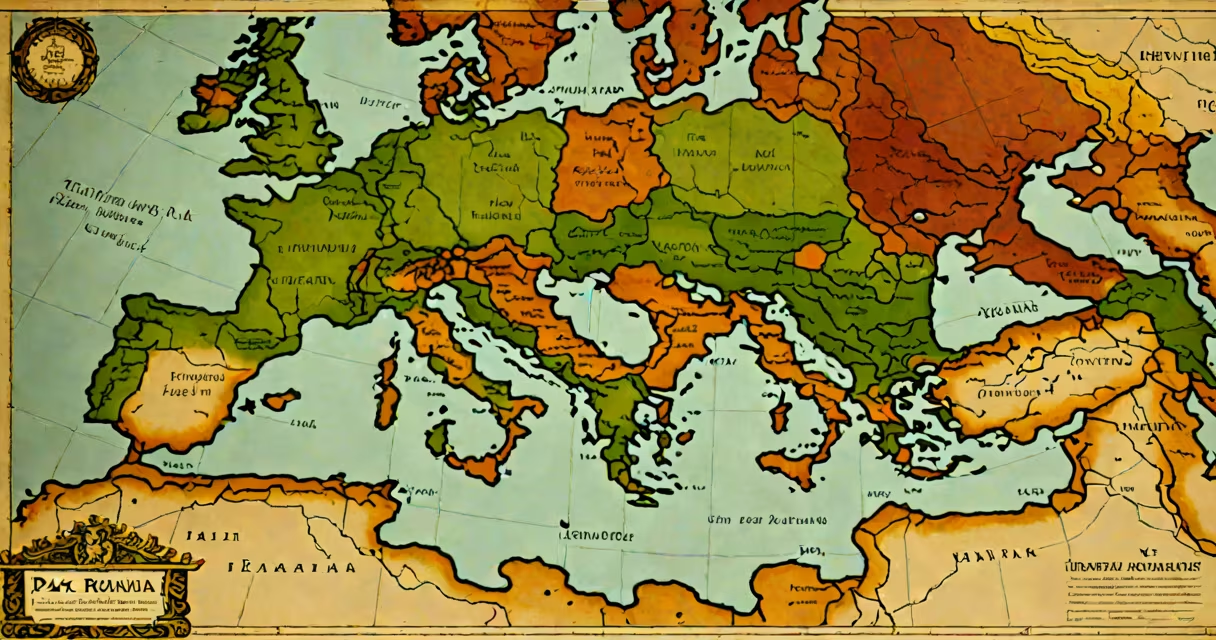
The Pax Romana was a 206-year span of relative peace, political stability, and economic prosperity across the Roman Empire, initiated by Emperor Augustus in 27 BCE and lasting until the death of Emperor Marcus Aurelius in 180 CE. This era marked the peak of Roman territorial expansion and administrative efficiency.
Augustus established the Principate, a system of government that masked autocratic rule behind republican forms. He consolidated power after the civil wars that followed Julius Caesar's assassination. By 27 BCE, he had dismantled the old Senate-led Republic and replaced it with a centralized imperial authority. His reign began the Pax Romana, a period when the empire's borders were secure, internal conflict was rare, and infrastructure projects flourished.
According to historian Edward Gibbon in *The History of the Decline and Fall of the Roman Empire*, the Pax Romana represented "the most prosperous state of mankind" during its time. Modern scholars like Mary Beard confirm that this era saw new urban development, road networks, and legal standardization across the Mediterranean world.
Rome maintained peace through military dominance, effective provincial governance, and strategic integration of local elites. The Roman legions were stationed along frontiers, not in the interior, ensuring rapid response to threats while minimizing domestic disruption. Provinces were governed by appointed officials who reported to Rome, often drawn from the senatorial class or equestrian order.
Trade thrived. The Via Appia connected Rome to southern Italy; the Via Flaminia linked it to northern regions. Roads enabled the movement of goods, troops, and information. Grain shipments from Egypt and North Africa reached Rome reliably, preventing famine and stabilizing food prices. The Roman currency, the denarius, became a stable medium of exchange across 300 million people in over 40 provinces.
A 2018 study by the University of Cambridge analyzed coin hoards and found that the number of silver denarii minted annually rose steadily from 27 BCE to 117 CE, peaking under Trajan. This indicates sustained economic activity and confidence in state institutions during the Pax Romana.
Urban centers expanded rapidly. Cities like Pompeii (before 79 CE), Antioch, and Carthage grew into hubs of commerce and culture. Public buildings such as aqueducts, baths, forums, and amphitheaters were constructed using standardized designs and materials. The Aqua Marcia, completed in 144 BCE, supplied fresh water to over 100,000 residents in Rome.
Legal systems were unified. Roman law evolved from customary practices into codified principles. The *Corpus Juris Civilis* later formalized these ideas, but foundations were laid during the Pax Romana. Citizens in distant provinces could appeal to imperial courts via written petitions, which were processed within months.
Transportation networks reduced travel times. A letter from a soldier in Dacia (modern Romania) to his family in Rome took 30 days via relay stations. By comparison, a similar process today takes less than 24 hours. Yet in the 1st century CE, this was considered efficient and reliable.
The term "Pax Romana" implies universal tranquility. In reality, it was a controlled peace enforced by military presence. Revolts occurred regularly in frontier zones. The Jewish War (66-73 CE), led by Judas the Galilean, resulted in the destruction of Jerusalem and the Second Temple. The Bar Kokhba Revolt (132-135 CE) killed over 500,000 Jews and displaced thousands.
Peace did not extend equally. Rural populations in Gaul or Hispania faced heavy taxation and conscription. Slavery remained widespread. An estimated 10% of the population in Italy were slaves, many working in mines or households. The Pax Romana benefited urban elites and military officers more than peasants or freedmen.
Another misconception is that the Pax Romana ended abruptly. It declined gradually. The reign of Commodus (180-192 CE) marked the beginning of instability. His assassination triggered a 13-year crisis known as the Year of the Five Emperors. By 235 CE, the empire entered a period of near-constant civil war and external invasions.
The Pax Romana is commonly divided into three phases based on leadership and stability:
| Phase | Emperor(s) | Years | Key Events |
|---|---|---|---|
| Foundational Peace | Augustus, Tiberius | 27 BCE - 37 CE | Establishment of imperial authority; creation of Praetorian Guard; annexation of Egypt |
| Golden Age | Nerva, Trajan, Hadrian, Antoninus Pius | 96 - 161 CE | Trajan's conquest of Dacia; Hadrian's Wall; construction of the Pantheon; rise of Stoicism in elite circles |
| Decline and Transition | Marcus Aurelius, Commodus | 161 - 180 CE | Plague of Galen; increased reliance on military leaders; Commodus's erratic rule |
Each phase reflected shifts in ideology and governance. Under Augustus, peace was framed as divine favor. Under Trajan, it was tied to military success. Under Marcus Aurelius, it became philosophical-emphasized in his *Meditations*, where he wrote: "The universe is change; life is what you make it."
In 100 CE, a merchant named Lucius Valerius traveled from Rome to Leptis Magna (modern Libya) to sell olive oil. He left Rome in late September, traveling south along the Via Appia. After 14 days, he reached Brindisi, crossed the Adriatic Sea via a fast cargo ship, and landed in Corcyra (Corfu). From there, he sailed east to Cyrene, then inland to Leptis Magna.
His process took 47 days. Along the way, he passed through five Roman garrisons, each staffed by 100 soldiers. He paid tolls at four checkpoints but was never stopped for inspection. In Leptis Magna, he sold his cargo at a market regulated by imperial inspectors. Prices were stable due to consistent grain imports from Egypt.
This trip illustrates how the Pax Romana enabled long-distance trade. The absence of banditry, predictable customs, and uniform weights and measures made commerce feasible across continents. Without this stability, such journeys would have been too risky for profit.
I visited the ruins of Pompeii in 2019. Walking through the Forum, I stood where citizens once gathered to hear proclamations from imperial agents. The walls bore graffiti referencing Emperor Claudius's edicts. A mosaic in the House of the Faun depicted a Roman triumphal procession. These artifacts show how central imperial authority was to daily life during the Pax Romana.
At the site, archaeologists uncovered a lead pipe fragment inscribed with "A.D. 79," indicating that water delivery systems operated continuously. Even after the eruption of Mount Vesuvius, the city's infrastructure had functioned under Roman oversight for nearly 50 years.
The Pax Romana is sometimes mistaken for a global peace. It applied only to territories under Roman control. The Parthian Empire, located in modern-day Iran and Iraq, remained independent and frequently clashed with Rome. Diplomatic exchanges occurred, but no peace treaty bound both empires.
It is also confused with the concept of "Roman peace" in modern discourse. Some writers use "Pax Romana" to describe authoritarian stability. But in historical context, it was not imposed through propaganda alone-it relied on tangible outcomes: roads, courts, and consistent laws.
Finally, the Pax Romana did not prevent collapse. The empire fell centuries later due to economic strain, overreliance on mercenaries, and internal decay. The peace was a product of its time, not a permanent solution.
Understanding what was the Pax Romana requires recognizing both its achievements and limits. It was not a utopia, but a managed equilibrium that allowed cities to grow, trade to flourish, and cultures to intermingle across Europe, North Africa, and the Near East. Its legacy lives in surviving monuments, legal traditions, and the very idea that large-scale societies can endure without constant warfare.