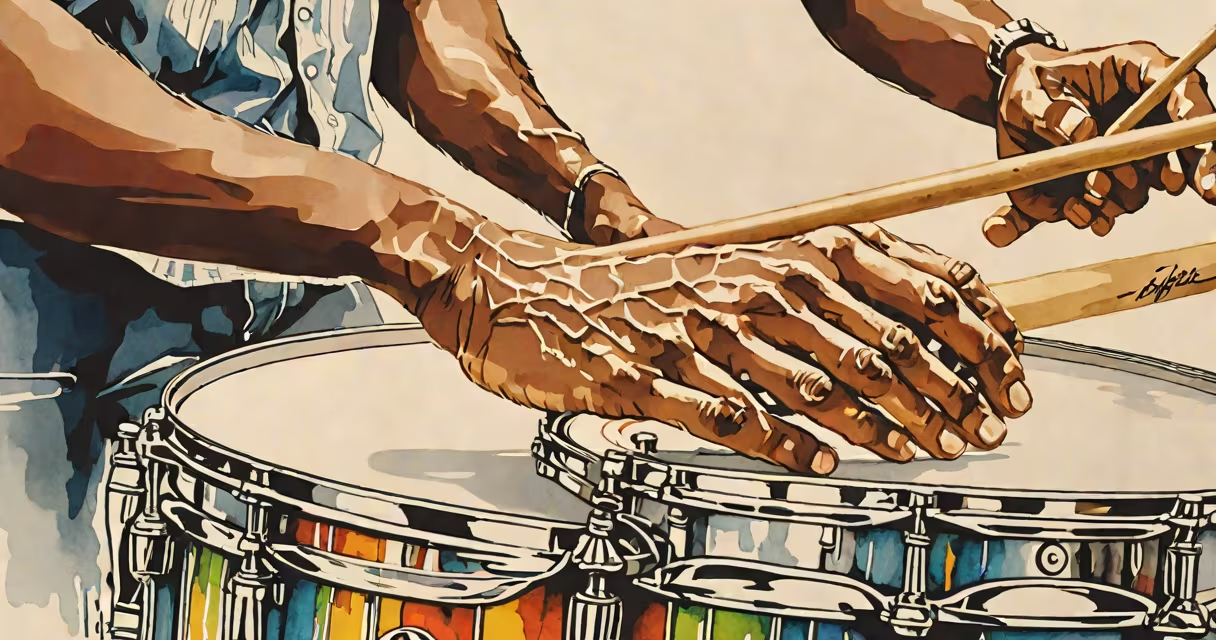
Rhythm in music is the structured arrangement of sounds and silences across time, defining the flow, pace, and accent patterns that give music its forward motion and emotional drive. It operates through consistent pulses, measured beats, and recurring groupings that listeners perceive as a steady heartbeat beneath melodies and harmonies.
Rhythm is not just about tempo-it's about how notes are spaced, grouped, and emphasized. A simple four-beat measure in 4/4 time creates a foundation for countless styles, from jazz swing to electronic dance music. The definition of rhythm in music includes both regularity and variation: while the underlying pulse remains stable, accents and syncopations disrupt expectations to create interest and energy.
For example, in a basic rock beat, the kick drum hits on beats one and three, the snare on two and four, and the hi-hat plays eighth notes throughout. This pattern establishes a clear rhythmic structure. But when a guitarist plays a note on the "and" of beat two-a syncopated placement-the rhythm feels more changing, even if the tempo hasn't changed. That shift is the essence of rhythm in action.
Rhythm functions through layers of timing and grouping. The smallest unit is the beat, which serves as the fundamental pulse. Beats are grouped into measures, typically marked by bar lines. Time signatures like 3/4 or 6/8 define how many beats appear per measure and which note value gets one beat.
Within those structures, musicians place notes and rests. A quarter note occupies one beat. An eighth note takes half a beat. When multiple rhythms play simultaneously-like a bassline moving in quarter notes while a drum fill uses sixteenth-note rolls-the result is polyrhythmic texture. This layering is common in African drumming, Indian tabla performances, and modern hip-hop production.
Consider the song "Seven Nation Army" by The White Stripes. Its iconic riff is built on a single repeating two-note pattern: D-G, played on the bass guitar. The rhythm is simple-two quarter notes per bar-but the repetition creates hypnotic momentum. The band maintains a steady 120 BPM, yet the listener feels tension because the bassline avoids the downbeat in the second bar. This subtle displacement makes the rhythm feel urgent, even though the tempo is unchanged.
Rhythm appears in distinct forms, each serving a different function in composition and performance. The table below outlines major rhythmic categories and their applications.
| Type | Description | Example |
|---|---|---|
| Regular | Evenly spaced beats with consistent accent patterns | Rock drum beat: kick on 1 and 3, snare on 2 and 4 |
| Syncopated | Emphasis on off-beats or weak beats, disrupting expected timing | "Billie Jean" by Michael Jackson - bassline hits on the "and" of 2 and 4 |
| Polyrhythmic | Two or more conflicting rhythms played simultaneously | West African djembe ensembles using 3:2 or 4:3 ratios |
| Free | No fixed meter or beat; relies on expressive timing | Improvised jazz solos, some avant-garde classical pieces |
Syncopation is often misunderstood as merely "playing off the beat." But it's more precise: syncopation occurs when a strong accent falls on a weak beat or between beats. In Afro-Cuban music, the clave rhythm-a two-bar pattern-uses syncopation to establish the core pulse. The clave itself is not a melody but a rhythmic blueprint that guides all instruments.
A non-obvious fact: the human brain detects rhythm not just through hearing, but through bodily movement. Studies show that people tap along to music even when they're not consciously aware of the beat. Research from the University of Cambridge found that neural activity in motor cortex regions aligns with perceived rhythm, suggesting our bodies are wired to respond to rhythmic structure-even when we're not dancing.
Rhythm is frequently mistaken for tempo, but they are distinct. Tempo refers to speed-how fast or slow the beat moves, measured in beats per minute (BPM). A song can have a slow tempo (60 BPM) but still feature complex rhythm. Conversely, a fast tempo (160 BPM) doesn't guarantee rhythmic sophistication.
Another confusion: rhythm versus melody. Melody is the sequence of pitches that form a tune. Rhythm controls when those pitches occur. A melody can be sung in different rhythms-same notes, different timing-and sound entirely different. Try singing "Happy Birthday" in triplets instead of quarter notes. The tune remains recognizable, but the rhythm changes the feeling.
Some assume that rhythm applies only to percussion. But every instrument contributes to rhythm. A pianist's left hand may play steady quarter notes while the right hand plays staccato eighth-note runs. The interplay creates rhythmic complexity even without drums.
Rhythm shapes genre identity. The 4/4 beat dominates pop and EDM, providing a predictable structure that supports danceable grooves. In contrast, jazz often uses swung eighth notes-where the first note of each pair is longer than the second-creating a relaxed, flowing motion that feels less rigid than straight eighths.
In reggae, the emphasis shifts to the "upbeat"-the second and fourth beats in a bar. This creates a sense of space and delay, making the music feel laid-back despite a steady tempo. The bassline often locks into this off-beat pattern, reinforcing the genre's signature groove.
I once recorded a live session with a Latin jazz ensemble. The drummer used a timbale to play a complex tresillo pattern-three eighth notes followed by a rest-over a standard 4/4 backing track. The result was a friction between the steady pulse and the irregular pattern. Listeners felt the tension, even if they couldn't explain why. That's rhythm in motion: it manipulates expectation and delivers surprise.
The definition of rhythm in music is not static. It evolves with culture and technology. Digital audio workstations allow producers to quantize notes to exact grid positions, creating perfect rhythmic precision. But many artists deliberately unquantize parts to restore human imperfection-slight timing variations that make recordings feel alive.
Understanding the definition of rhythm in music means recognizing it as both a structural tool and an emotional force. It's not just about counting beats-it's about how those counts make us move, feel, and remember.