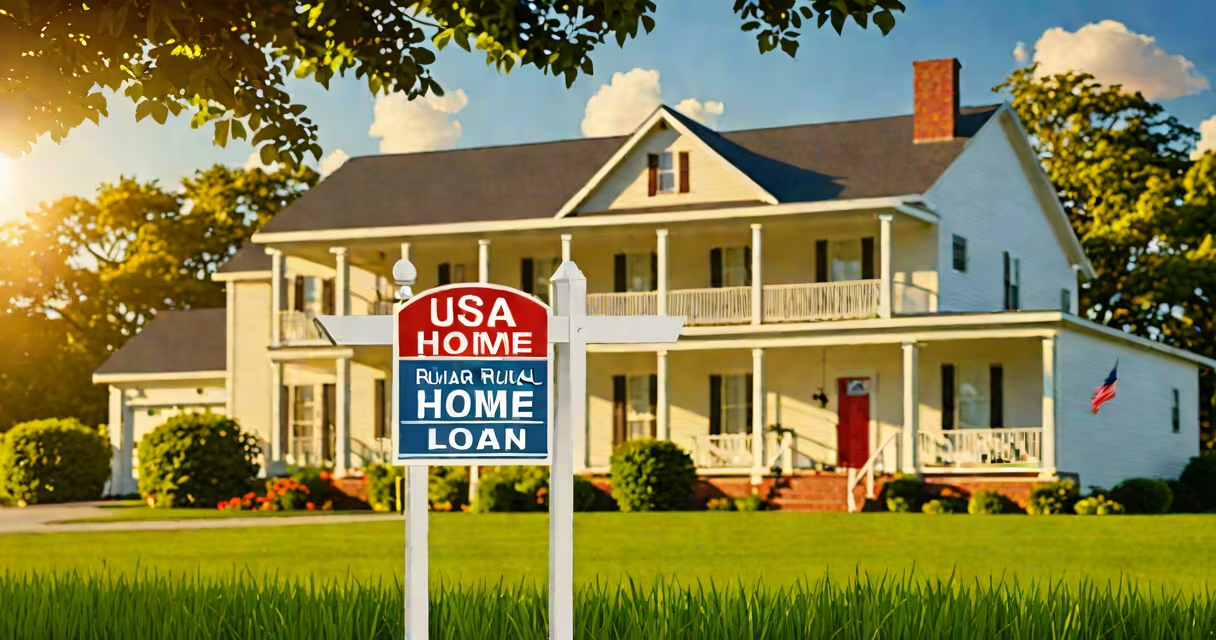
The USDA rural home loan is a government-backed mortgage program that allows qualified borrowers to purchase homes in eligible rural areas with no down payment required. Administered by the U.S. Department of Agriculture, it targets low- to moderate-income households in communities with limited access to traditional financing.
This loan aims to stimulate economic development in rural regions by making homeownership accessible to those who might otherwise qualify for conventional mortgages. Unlike standard home loans, it requires no down payment and offers competitive interest rates. The program applies only to properties located in USDA-designated rural zones, which are mapped based on population density and infrastructure availability.
According to the USDA's official guidelines, a rural area is defined as a location with a population under 20,000 and not within a metropolitan statistical area (MSA). Properties in towns like Pine Ridge, South Dakota, or parts of eastern Kentucky meet these criteria. The program is not available in urban centers or suburban areas, even if they're geographically remote.
USDA rural home loans are issued through approved lenders, such as credit unions and banks, that have been certified by the USDA. Borrowers apply through these institutions, which then submit the application to the USDA for approval. The process includes credit checks, income verification, and property appraisal to ensure the home meets safety and structural standards.
Once approved, the borrower receives a loan amount equal to 100% of the home's purchase price. However, borrowers must pay both an upfront guarantee fee (1% of the loan amount) and an annual fee (0.25% of the outstanding balance), which are added to the monthly payment. These fees fund the program's risk pool and ensure long-term sustainability.
For example, a $200,000 home in a qualifying rural zone would require no down payment. The upfront fee would be $2,000, and the annual fee would be $500 ($200,000 × 0.25%). Over a 30-year term at 4.5% interest, the monthly payment would include principal, interest, and these fees-totaling approximately $1,060, compared to $1,000 without the fees.
To qualify, applicants must meet income limits set by the USDA based on county median income. For most areas, gross household income cannot exceed 115% of the local median. In high-cost regions like parts of California or New York, the limit may be higher due to adjusted affordability thresholds.
Borrowers must also intend to occupy the home as their primary residence. Second homes, investment properties, and vacation homes are ineligible. The property must be located in a USDA-approved rural area, and the borrower must have a minimum credit score of 640 for automatic approval. Scores below 640 require manual underwriting and may result in denial unless extenuating circumstances exist.
A common misconception is that the USDA loan is only for people with poor credit. While it accepts lower scores than conventional loans, it still requires responsible financial behavior. A borrower with a 620 score may be denied even if income qualifies, because the USDA prioritizes long-term repayment stability.
| Requirement | USDA Rural Loan | Conventional Loan |
|---|---|---|
| Down Payment | 0% | Minimum 3%-20% |
| Monthly Mortgage Insurance | Annual fee (0.25%) + upfront fee (1%) | PMI (0.3%-1.5%) until 20% equity |
| Income Limit | 115% of area median income | No formal cap, but lender sets limits |
| Credit Score Minimum | 640 (automatic approval) | 620 (varies by lender) |
Many assume the USDA rural home loan is a "free" loan because it requires no down payment. This is incorrect. The upfront and annual fees represent real costs. Over time, these fees can increase the total borrowing cost compared to a conventional loan with a 10% down payment.
Another misunderstanding is that the program applies to all rural areas. In reality, only properties in USDA-designated rural zones qualify. You can verify eligibility using the USDA's online property eligibility map. A home in a town with 18,000 residents may be excluded if it lies within a larger metro area's commuting zone.
I once reviewed a case where a family in western North Carolina was denied because their home was just outside the boundary of a designated rural area. The town had a population of 19,800, which technically fell under the 20,000 threshold-but the USDA considers proximity to urban centers when defining eligibility. The family later moved 15 miles west into a qualifying zone and were approved.
Use this loan if you're buying a home in a rural area, earn below the local median income, and want to avoid a down payment. It's ideal for first-time buyers, teachers, healthcare workers, and public servants living in small towns with limited housing options.
The USDA rural home loan is a targeted solution for underserved populations in rural America. It reduces barriers to homeownership but demands careful planning around fees, income limits, and geographic boundaries. Understanding these factors ensures you don't misapply or overestimate your chances of approval.