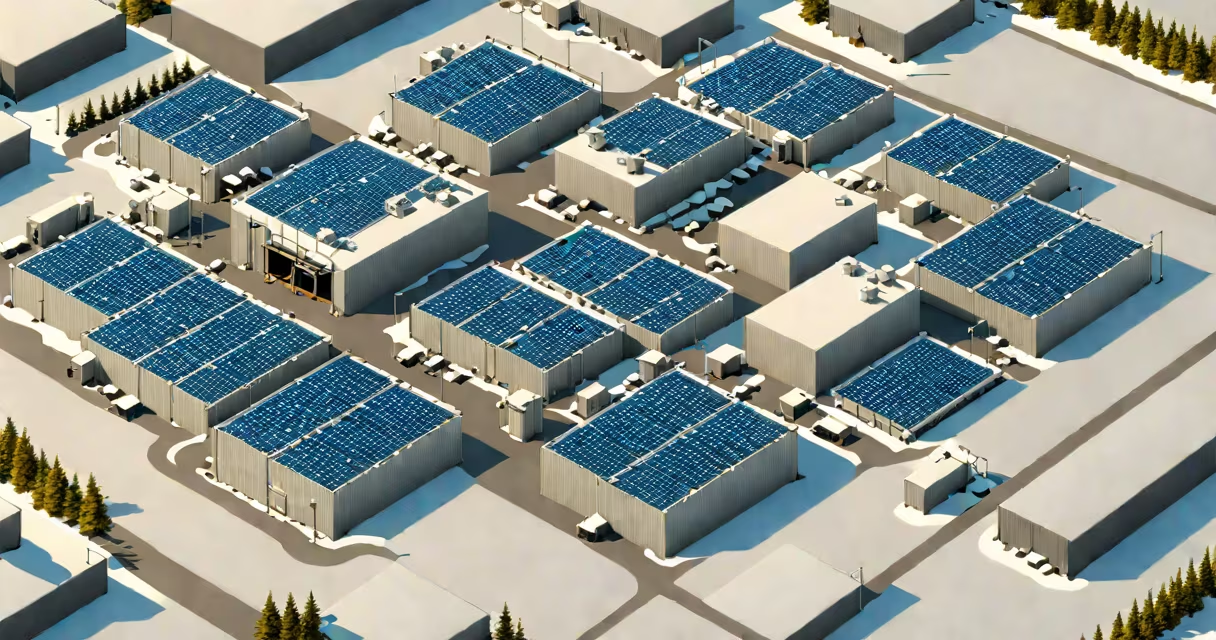
Bitfarms is a publicly traded Canadian company that owns and operates large-scale Bitcoin mining facilities, primarily in Quebec and Texas. It uses specialized hardware called ASIC miners to validate transactions on the Bitcoin blockchain and earn newly minted Bitcoin as rewards.
Bitcoin mining requires solving complex cryptographic puzzles to secure the network and add new blocks. Bitfarms runs thousands of ASIC miners continuously, consuming electricity to perform these calculations. The company earns revenue by receiving Bitcoin rewards and transaction fees for successfully adding blocks to the chain.
Unlike speculative crypto traders, Bitfarms functions as a physical infrastructure operator. It does not trade Bitcoin for profit but holds mined coins as assets. Its business model depends on low-cost electricity, stable regulatory environments, and efficient hardware management.
Bitfarms runs mining operations through purpose-built data centers. These facilities house racks of ASIC miners-specialized machines designed exclusively for Bitcoin hashing. Each miner performs trillions of hash calculations per second, competing with global networks to solve cryptographic puzzles.
The company's primary location is in Quebec, where hydroelectric power provides low-cost, renewable energy. A secondary site in Texas leverages a mix of wind and grid power. This dual-location strategy reduces exposure to regional energy price volatility and regulatory shifts.
Bitfarms monitors real-time performance via centralized software. Operators track hash rates, power consumption, temperature, and failure rates across thousands of devices. Maintenance teams replace failed units within hours to minimize downtime and maximize block reward capture.
Bitfarms uses high-efficiency ASIC miners from manufacturers like Bitmain and MicroBT. As of Q1 2024, the company operated approximately 160,000 ASIC units, with a combined hashrate exceeding 200 petahashes per second (PH/s).
Each ASIC miner consumes between 3,000 and 4,000 watts of power. With 160,000 units running 24/7, the total electricity draw averages around 500 megawatts-equivalent to powering a small city. Bitfarms contracts long-term power agreements at rates below $0.04/kWh in Quebec, lower than U.S. national averages.
Hardware upgrades occur every 12-18 months. Newer models offer higher efficiency, reducing cost per hash. For example, the Bitmain Antminer S21 (2023) delivers 190 TH/s at 31.5 J/TH, compared to older models at 40+ J/TH. Bitfarms prioritizes hardware with the lowest energy-to-hash ratio to maintain profitability during price swings.
| Location | Hashrate (PH/s) | Energy Source | Power Cost (USD/kWh) | Number of Miners |
|---|---|---|---|---|
| Quebec, Canada | 135 | Hydroelectric | $0.035 | 105,000 |
| Texas, USA | 65 | Wind + Grid | $0.055 | 55,000 |
Bitfarms secures the Bitcoin network by contributing computational power. Every time a new block is mined, the network adjusts difficulty to maintain a 10-minute average block time. Bitfarms' participation ensures decentralization and resistance to tampering.
As of May 2024, the Bitcoin network's total hashrate exceeded 700 exahashes per second (EH/s). Bitfarms contributes roughly 0.03% of this global capacity. While small in percentage, its consistent output supports network stability and enables faster transaction confirmation times.
Unlike companies that mine for resale, Bitfarms holds mined Bitcoin as a long-term asset. The company reports quarterly production figures and discloses holdings in filings with the Canadian Securities Exchange (CSE). In Q1 2024, Bitfarms mined 1,234 BTC, valued at approximately $74 million at market prices.
Many assume Bitfarms mines Bitcoin to sell it immediately for cash. This is incorrect. The company does not speculate on price movements. Instead, it treats Bitcoin as a capital asset, similar to gold or real estate.
Another misconception is that mining is purely profitable when Bitcoin prices rise. Bitfarms' financial model accounts for volatility. The company uses forward contracts to hedge against price drops and maintains liquidity reserves to cover operational costs during downturns.
A lesser-known fact: Bitfarms is one of the few mining firms to publish detailed environmental impact reports. According to its 2023 sustainability report, 98% of its energy comes from renewable sources. This exceeds the average for North American mining operations, which rely more heavily on fossil-fuel-based grids.
I visited Bitfarms' facility in Quebec in February 2024. The building resembled a warehouse with climate-controlled server rooms. Inside, rows of black ASIC units hummed quietly under LED lighting. Temperatures stayed below 25°C due to passive cooling and ambient air intake.
During the visit, a team replaced a failed miner. The process took less than 15 minutes. A technician disconnected the unit, swapped in a new one, and rebooted the system remotely. Downtime was negligible. The facility ran at 99.8% uptime over the previous quarter.
One example illustrates the scale: In March 2024, Bitfarms earned 420 BTC from mining activity. At a Bitcoin price of $61,000, this equated to $25.6 million in revenue. After subtracting $12.3 million in electricity and maintenance costs, the company reported a net profit of $13.3 million on the mining segment alone.
What does Bitfarms do? It operates large-scale Bitcoin mining infrastructure using renewable energy and advanced hardware. The company generates revenue by earning block rewards and transaction fees while maintaining a focus on sustainability and operational efficiency. Its role in securing the Bitcoin network remains critical as blockchain adoption grows.