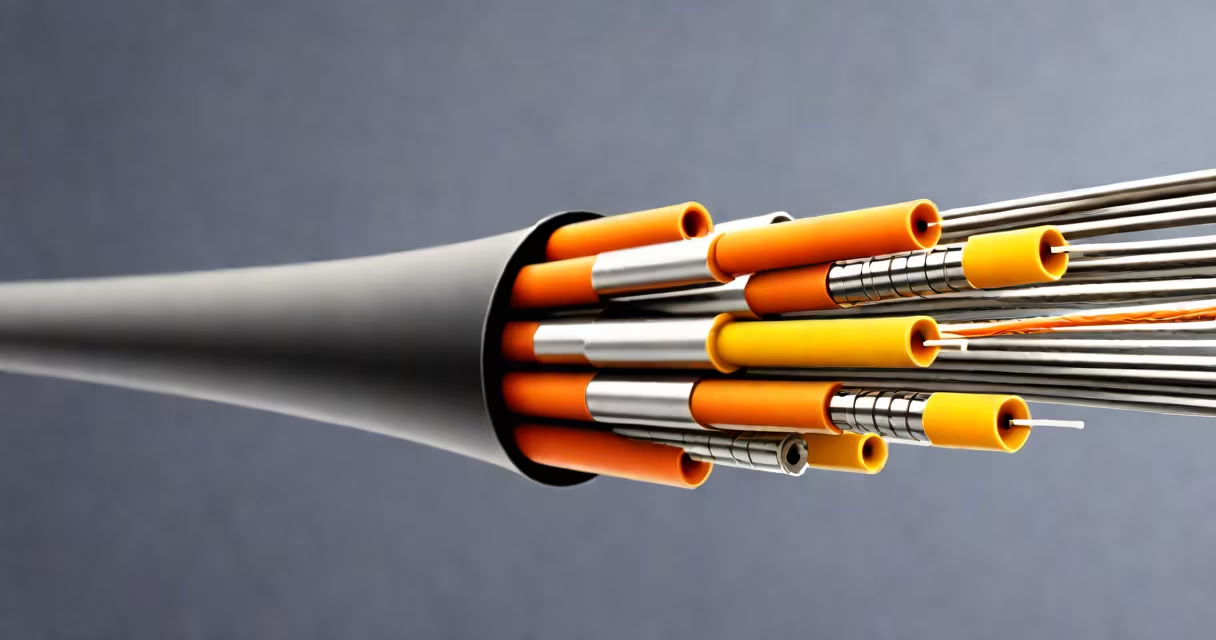
Multimode is a type of optical fiber that supports multiple light paths (modes) through its core, allowing simultaneous transmission of data over short distances at high speeds. It is commonly used in local area networks (LANs), data centers, and enterprise environments where bandwidth demands are high but distances are limited.
Unlike single-mode fiber, which uses a narrow core and a single light path, multimode fiber has a wider core-typically 50 or 62.5 micrometers-that allows several light rays to propagate at different angles. This design enables higher data throughput over short runs but limits distance due to modal dispersion, where different light paths arrive at slightly different times.
The term "multimode" describes the physical behavior of light within the fiber. It is not a brand, protocol, or standard-it is a fundamental characteristic of fiber construction. Multimode fiber is often paired with specific laser types and transceivers, such as those using vertical-cavity surface-emitting lasers (VCSELs), to achieve optimal performance.
Light enters the multimode fiber's core at various angles, creating multiple propagation paths. These paths are called modes. Because each mode travels a different distance through the fiber, they arrive at the receiver at slightly different times-a phenomenon known as modal dispersion. Over long distances, this causes signal spreading and reduces data integrity.
To manage this, multimode systems use shorter wavelengths (850 nm and 1300 nm) and specialized transmitters like VCSELs. These lasers emit focused light that stays within the core's effective range, minimizing overlap between modes. The result is stable data transmission up to 550 meters for newer grades, depending on the specification.
For example, OM3 multimode fiber supports 10 Gbps Ethernet over 300 meters. OM4 extends that to 550 meters. Older OM1 and OM2 fibers, with larger cores and lower bandwidth, are limited to 1 Gbps over 300 meters and 100 meters respectively. These differences stem from improvements in fiber manufacturing and tighter control over refractive index profiles.
There are four primary categories of multimode fiber, designated by the ISO/IEC 11801 standard. Each grade improves bandwidth and reach compared to the last.
| Fiber Type | Core Diameter | Bandwidth (MHz·km) | Max Distance (10 Gbps) | Common Use Cases |
|---|---|---|---|---|
| OM1 | 62.5 µm | 200 | 33 meters | Legacy installations, low-speed applications |
| OM2 | 50 µm | 500 | 82 meters | Older campus networks, basic data links |
| OM3 | 50 µm | 1500 | 300 meters | Modern data centers, 10 Gbps links |
| OM4 | 50 µm | 3500 | 550 meters | High-performance data centers, 40/100 Gbps |
OM3 and OM4 are the most widely deployed today. They use laser-optimized 50 µm cores and are designed specifically for VCSEL-based transceivers. OM5, a newer standard, supports wavelength division multiplexing (WDM) over multiple wavelengths, increasing capacity without replacing infrastructure.
A non-obvious distinction: while OM3 and OM4 are both 50 µm, their refractive index profiles differ. OM4 has a tighter gradient, reducing modal dispersion and extending reach. This difference is critical when upgrading a network-using OM4 cables with older equipment may not yield gains unless the transceivers support the improved profile.
Most enterprise networks deploy multimode fiber for connections within buildings or between adjacent structures. Data centers frequently use OM4 for server-to-switch links, especially in 10 Gbps and 40 Gbps configurations. The cost of multimode transceivers is lower than single-mode equivalents, making it economical for short-haul deployments.
For example, a university IT department installed OM4 fiber between its computer science building and library. The run was 420 meters. Using 10 Gbps SFP+ modules, the connection achieved full bandwidth with no packet loss. The team chose multimode because the distance was under 550 meters and the cost of single-mode components would have added $1,200 per port without benefit.
Another common use is in surveillance systems. Security cameras transmitting HD video over fiber can use multimode for runs under 500 meters. A retail chain upgraded its store security network using multimode fiber and PoE switches, reducing installation time by 40% compared to copper alternatives.
Many assume multimode fiber is outdated or inferior. That's incorrect. While single-mode fiber handles longer distances and higher bandwidths, multimode remains essential for short-range, high-density applications. It is not obsolete-it is purpose-built.
Another misconception: multimode and single-mode cables look similar. They are both glass, have protective jackets, and are terminated with standard connectors like LC or SC. However, the core size and refractive index profile differ. A visual inspection won't reveal the difference-only testing with an OTDR (optical time-domain reflectometer) or checking the labeling can confirm the type.
I once observed a technician replace a broken multimode cable with a single-mode one during a data center upgrade. The switch failed to detect the link. The issue wasn't the cable-it was the mismatched transceiver. Single-mode transceivers require precise alignment and narrow spectral width. Using them with multimode fiber caused excessive loss. The fix required swapping the transceiver, not the cable.
Finally, multimode is not synonymous with "multi-wavelength." Wavelength division multiplexing (WDM) requires specific fiber types. Standard multimode (OM3/OM4) supports only one wavelength per channel. For WDM, OM5 fiber is required. Mixing standards leads to signal degradation and reduced reliability.
Multimode is a practical solution for high-speed data transmission over short distances. Its design balances cost, performance, and ease of installation. Understanding the differences between OM1 through OM5 grades ensures proper deployment and avoids costly errors. When selecting fiber, match the type to the application's distance, speed, and budget requirements.