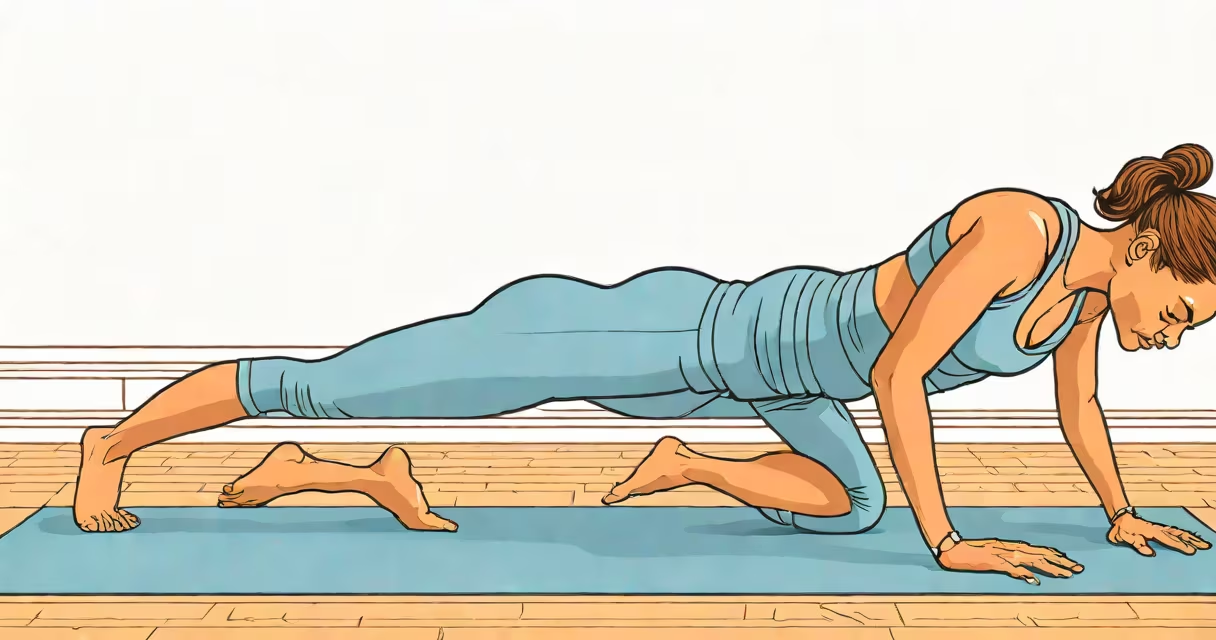
Core exercise refers to any movement that activates the muscles surrounding the torso-primarily the rectus abdominis, transverse abdominis, internal and external obliques, and lower back stabilizers-to improve stability, posture, and functional strength. These exercises train the body's central region to resist unwanted motion during daily tasks and athletic performance.
The core is not just the six-pack muscles. It includes deeper stabilizing layers that work automatically to brace the spine during lifting, twisting, or sudden shifts in balance. A well-trained core reduces strain on the lower back and improves coordination between limbs and trunk.
For example, when you carry groceries up stairs, your core engages to prevent your torso from collapsing sideways. Without core strength, this simple task increases risk of back pain. Core exercise trains this automatic response through targeted repetition.
Core exercise functions by activating deep stabilizer muscles before larger limb muscles fire. This sequence-called feed-forward activation-is critical for injury prevention. Research shows that people with chronic low back pain often fail to activate their transverse abdominis early enough during movement, leading to excessive spinal loading.
When you perform a dead bug or bird-dog, your brain sends signals to the transverse abdominis and multifidus muscles before your arms or legs move. This creates a stable base. Over time, consistent practice makes this stabilization reflex faster and more efficient.
Studies from the Journal of Orthopaedic & Sports Physical Therapy confirm that targeted core training reduces recurrent low back pain by 30-50% in patients who complete 8 weeks of supervised exercises. The effect is strongest when exercises emphasize control over speed or reps.
The core consists of four primary muscle groups:
| Group | Function | Example Exercise |
|---|---|---|
| Rectus abdominis | Flexes the spine; responsible for visible "six-pack" appearance | Crunches, leg raises |
| Transverse abdominis | Compresses abdominal contents; acts like a corset around the spine | Dead bugs, hollow body holds |
| Internal and external obliques | Rotates and laterally bends the trunk; stabilizes during twisting motions | Side planks, Russian twists |
| Lumbar extensors and multifidus | Stabilize the lower back; maintain upright posture | Superman, prone bridges |
Each group responds best to different movement patterns. For instance, the transverse abdominis activates most effectively during slow, controlled movements with breath control. The obliques respond strongly to rotational challenges like medicine ball throws.
Many people assume that sit-ups are the gold standard for core training. But research from the American Council on Exercise shows that sit-ups generate 40% higher compressive force on the lumbar spine compared to planks. This increases wear on discs and may contribute to long-term back issues.
Core exercise appears in rehabilitation programs for athletes and office workers alike. Physical therapists prescribe core-focused routines to treat conditions like herniated discs, sciatica, and poor posture. A 2021 study published in the British Journal of Sports Medicine found that participants with desk-related neck and shoulder tension improved after 6 weeks of daily core activation drills.
Strength coaches use core exercise to improve power transfer. In sports like football, basketball, and tennis, explosive movements rely on a stable trunk to channel energy efficiently. A player who lacks core control loses 15-20% of their sprint efficiency due to energy leakage through the torso.
I once observed a client struggling with knee pain during squats. After testing movement patterns, we discovered she was collapsing into her hips and lower back because her core wasn't engaging. Once we added dead bugs and pelvic tilts to her warm-up, her squat form improved within two sessions. Her knee pain resolved after three weeks of consistent practice.
People often confuse core exercise with ab-specific workouts. While crunches isolate the rectus abdominis, they don't train the full functional role of the core. True core training involves multiplanar stability-resisting rotation, flexion, and lateral bending simultaneously.
Another myth is that more reps equal better results. High-repetition crunches increase fatigue but do little to build neuromuscular control. The National Academy of Sports Medicine recommends focusing on quality over quantity: 3 sets of 10-15 seconds per exercise, with full breath control.
Some think core exercise requires equipment. Bodyweight movements like planks, bird-dogs, and hollow holds are effective and accessible. You don't need a gym membership to strengthen your core.
Consider a 42-year-old office worker who lifts a 20-pound box from a shelf. Without core engagement, the spine absorbs the load unevenly. The vertebrae compress, and ligaments stretch. With proper core activation, the transverse abdominis contracts first, creating intra-abdominal pressure that supports the spine.
To simulate this, try the following 3-minute circuit:
Perform this daily for two weeks. You'll notice less stiffness in the morning and improved balance when walking on uneven ground.