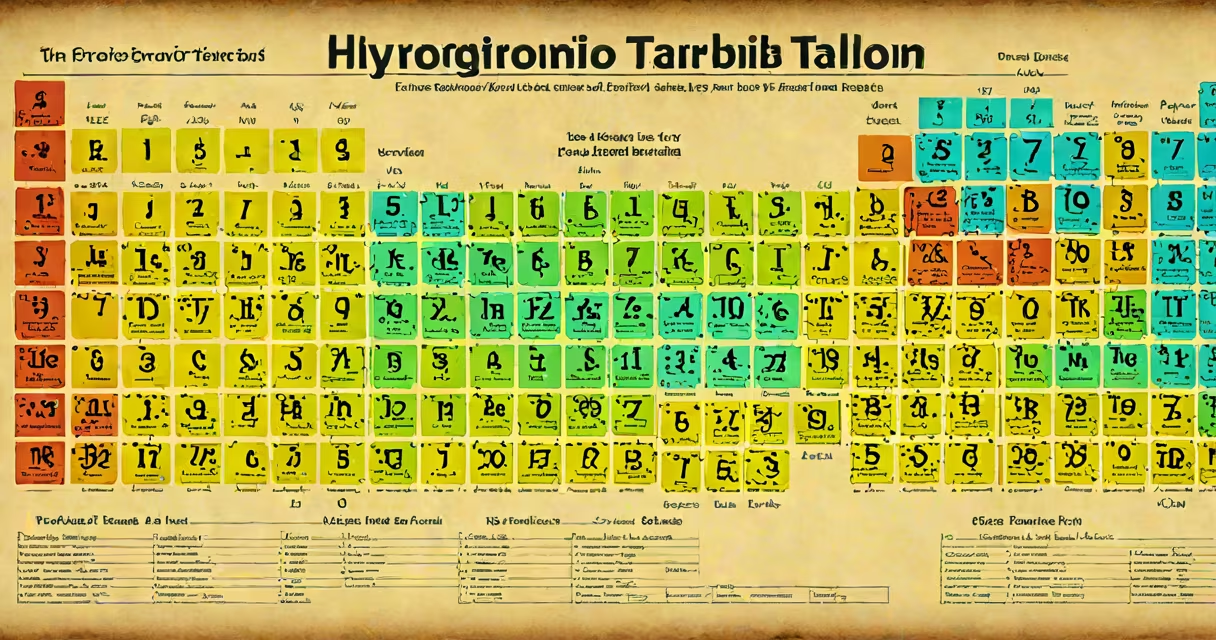
The number of protons in an atom's nucleus-its atomic number-defines each element on the periodic table. Hydrogen has one proton, helium has two, and uranium has 92. This count never changes for a given element and determines its position and chemical behavior.
Every element on the periodic table is uniquely identified by its proton count. This number, known as the atomic number, appears above the element's symbol in each box. For example, carbon's atomic number is 6, meaning every carbon atom contains exactly six protons. Change that number, and you change the element itself.
Proton count is not arbitrary. It governs electron configuration, which in turn dictates how atoms bond and react. Elements with similar proton counts fall into groups with shared properties-like fluorine (9 protons) and chlorine (17 protons), both highly reactive halogens.
Atoms are composed of protons, neutrons, and electrons. Protons reside in the nucleus and carry a positive charge. The number of protons determines the element's identity because it defines the total positive charge in the nucleus. This charge attracts exactly that many electrons in a neutral atom, forming the electron cloud responsible for chemical interactions.
For example, nitrogen has seven protons. Any atom with seven protons is nitrogen, regardless of neutron count. An isotope of nitrogen may have seven or eight neutrons, but the proton count remains fixed. This stability ensures consistency in elemental classification.
According to the International Union of Pure and Applied Chemistry (IUPAC), the atomic number is the defining characteristic of an element. IUPAC states that "elements are defined by their atomic number, not by mass or electron count." This principle underlies all modern periodic table organization.
Elements are grouped by proton count, ranging from 1 (hydrogen) to 118 (oganesson), the highest confirmed element. The periodic table arranges elements in increasing order of atomic number, creating repeating patterns in physical and chemical properties.
| Proton Count | Element | Group | State at Room Temp |
|---|---|---|---|
| 1 | Hydrogen | 1 | Gas |
| 6 | Carbon | 14 | Solid |
| 17 | Chlorine | 17 | Gas |
| 79 | Au (Gold) | 11 | Solid |
Elements with low proton counts (1-20) are mostly metals or nonmetals found in nature. Those with higher counts (beyond 83) are typically unstable and undergo radioactive decay. Bismuth (83 protons) is the heaviest stable element; everything beyond it decays over time.
One non-obvious fact: the periodic table's structure reflects proton count, not atomic mass. For example, argon (18 protons) has a higher atomic mass than potassium (19 protons), yet argon appears before potassium. This reversal occurs because the table orders by proton count, not weight.
Many assume that atomic mass or electron count defines an element. This is incorrect. A sodium ion (Na⁺) loses one electron but still has 11 protons-it remains sodium. Changing the proton count turns it into magnesium.
Another misconception is that proton count varies within an element. It does not. All atoms of oxygen have eight protons. Variations in neutron count create isotopes, but proton count stays constant. Carbon-12 and carbon-14 differ in neutrons but share 6 protons.
In nuclear medicine, knowing proton count is essential. Technetium-99m, used in imaging scans, has 43 protons. Its isotope form allows safe tracking in the body due to precise proton-electron balance.
Consider lithium-7, used in batteries. Lithium has 3 protons. The isotope has 4 neutrons, but the proton count remains 3. This consistency ensures predictable electrochemical behavior across all lithium-based devices.
During my time working in a university lab, we analyzed unknown samples using mass spectrometry. We measured ion masses and inferred proton counts via charge-to-mass ratios. One sample showed a peak at 14 amu with +1 charge-indicating 14 protons. That matched nitrogen-14, confirming the presence of nitrogen in a soil sample.
Proton count is foundational to chemistry. It's not just a number-it's the key to identifying, classifying, and predicting how elements behave. Every entry on the periodic table begins with this single, unchanging value.
The number of protons on the periodic table is the core determinant of elemental identity. From hydrogen to oganesson, each element's place is fixed by its proton count. This principle enables accurate scientific communication, material design, and technological innovation.